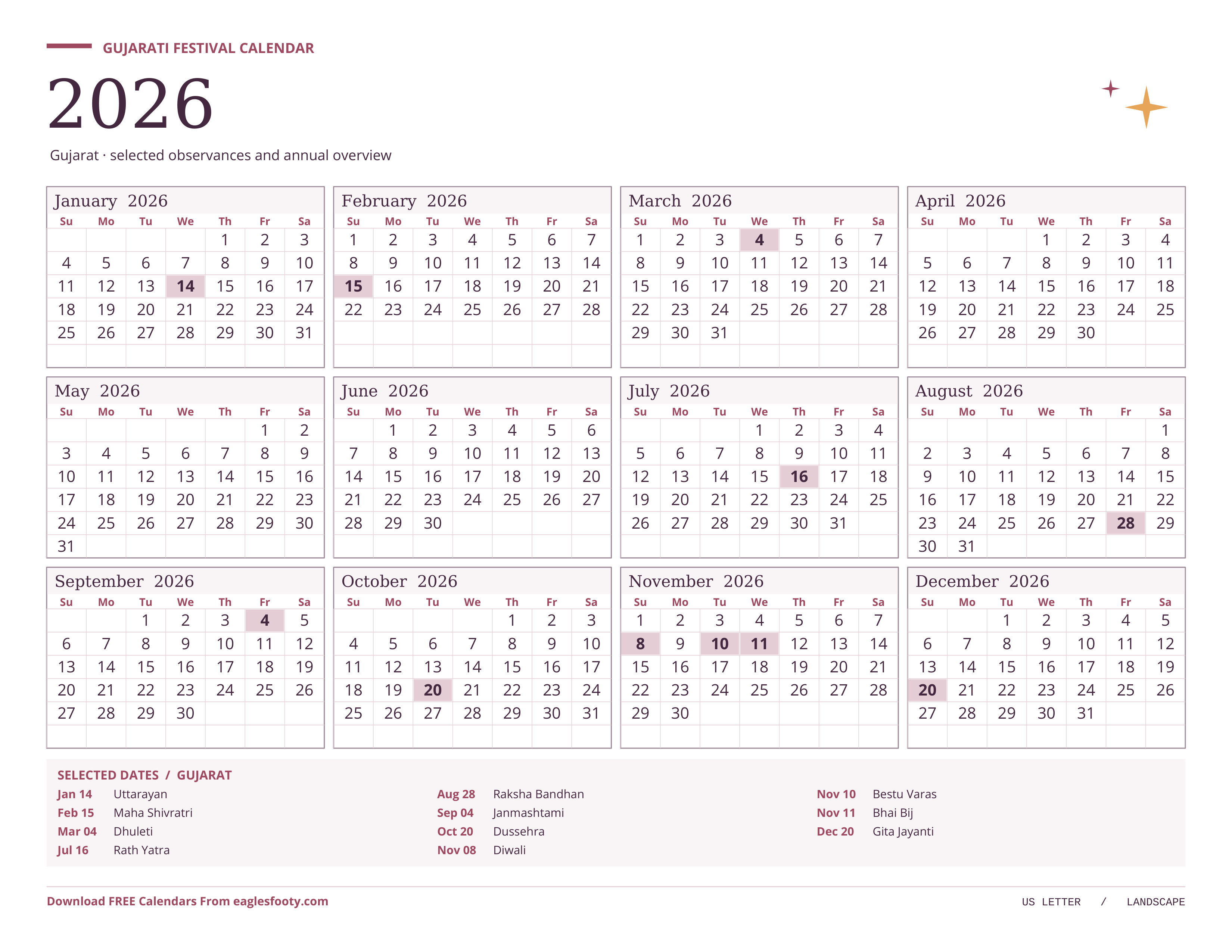
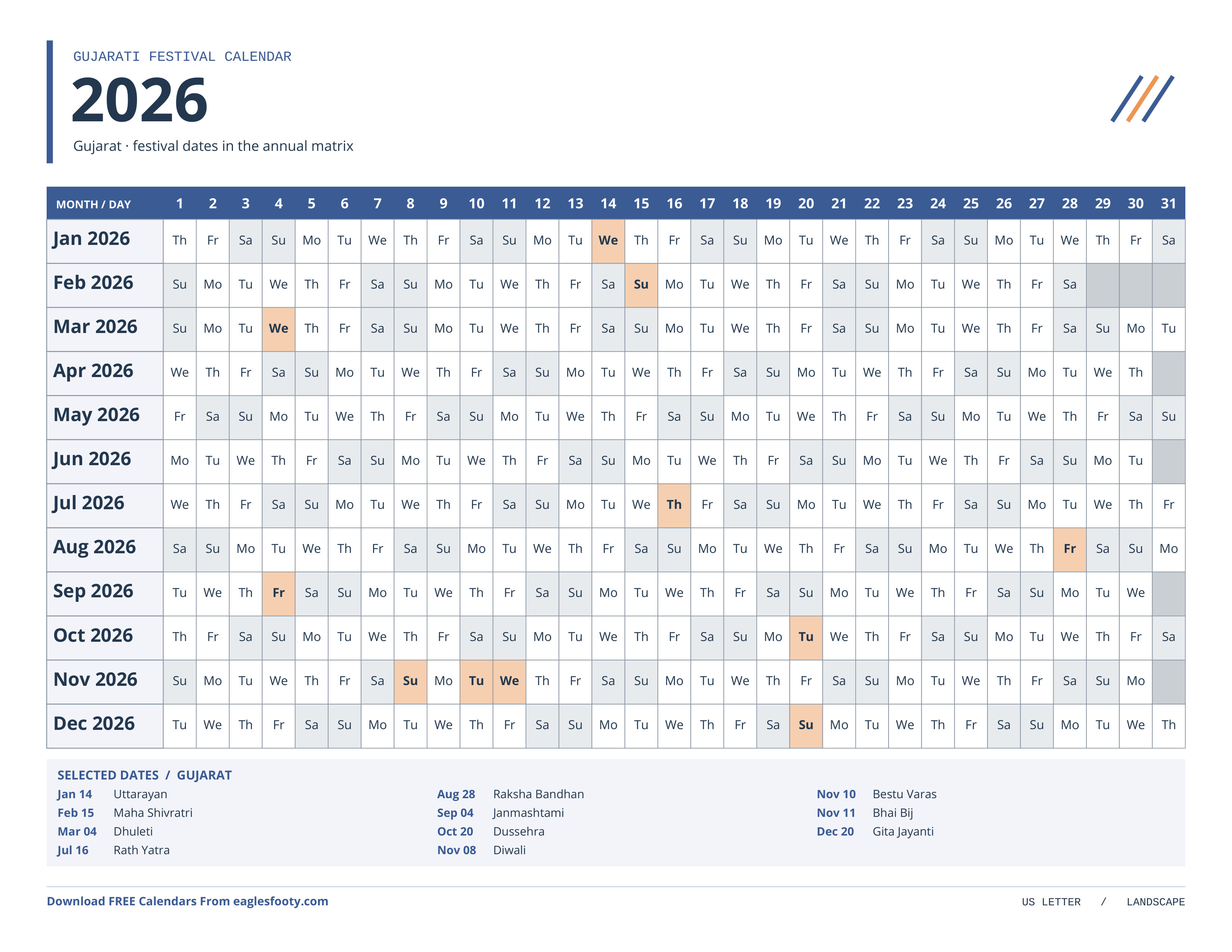
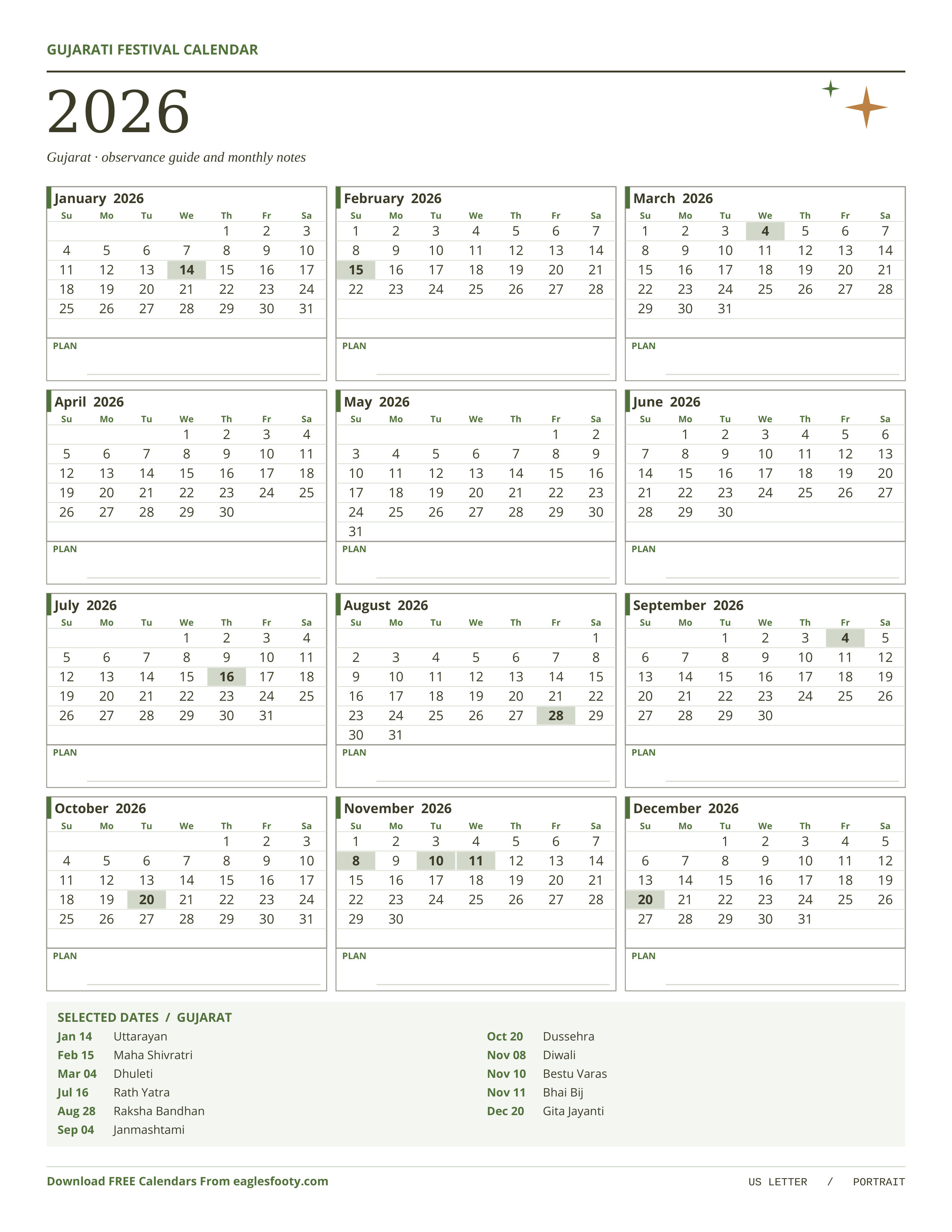
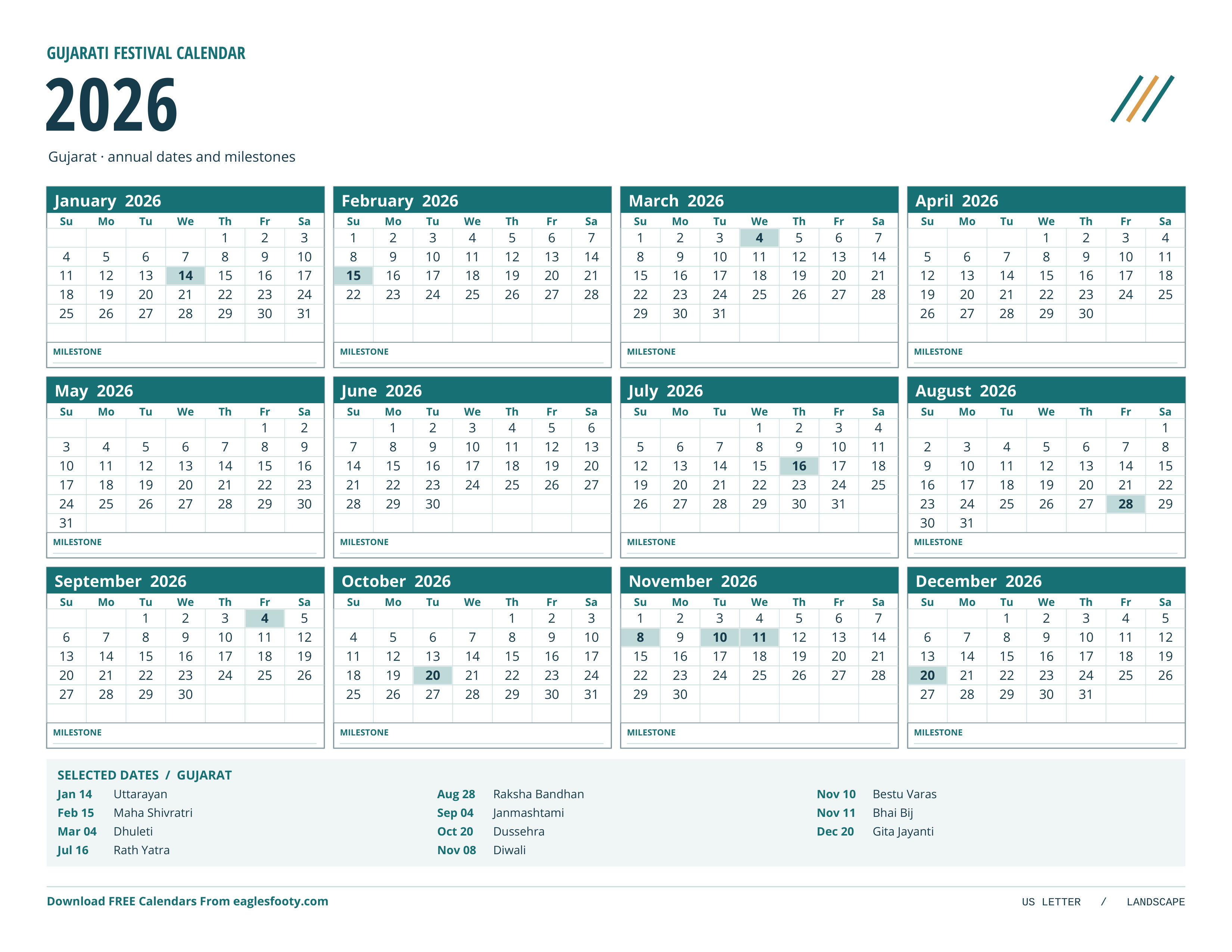
Gujarati Calendar 2026 January to December brings all twelve civil months together with Gujarat festival dates and the November change from Vikram Samvat 2082 to 2083. Uttarayan falls on January 14, Dhuleti on March 4, and Bestu Varas on November 10. Use the Gregorian panels to plan travel or gatherings while keeping the Gujarati names that appear on family invitations.
Pair your Gujarat festival planner with a US month sheet from the December 2026 Calendar collection.
Gujarati Calendar 2026 January to December: All 12 Months
What Year Is It on the Gujarati Calendar?
January 1 starts a new Gregorian year, while the Gujarati new year arrives in the autumn festival season. In 2026, Kartak Sud Ekam falls on Tuesday, November 10. The printed year therefore contains part of Samvat 2082 and part of 2083. If you are dating a family letter in November, write the full civil date as well as the Samvat year. A November heading by itself does not tell the reader which of the two years applies.
Month names need a little care too. A Gujarati lunar month crosses the boundary between two civil months. The bright half is called Sud and the dark half Vad. A family might give a traditional date as a month name followed by a half and a day, for example Kartak Sud Ekam. Keep all three parts together. The number alone repeats during the month and will not identify a festival reliably.
Gujarati Calendar 2026, January to December: Gujarat Dates
| Civil Date in 2026 | Gujarati Occasion | How to Use the Entry |
|---|---|---|
| Wednesday, January 14 | Uttarayan, or Makar Sankranti | Put the local kite gathering on its actual advertised date. |
| Sunday, February 15 | Maha Shivratri | Check evening service times if your family plans to attend. |
| Wednesday, March 4 | Dhuleti | Use the daytime celebration date on a school or community invitation. |
| Friday, August 28 | Raksha Bandhan | Leave time for mailing a rakhi if relatives live apart. |
| Friday, September 4 | Janmashtami | Confirm the service time with the temple hosting it. |
| Sunday, November 8 | Diwali | Enter a home observance separately from a hall booking. |
| Tuesday, November 10 | Bestu Varas | Mark the beginning of Vikram Samvat 2083. |
| Wednesday, November 11 | Bhai Bij | Reserve a separate space for visits or calls with siblings. |
Planning the November Festival Sequence
The gap between Diwali on November 8 and the new year on November 10 is easy to miss if you simply count forward from a familiar phrase like “after Diwali.” Use this year’s dated listing for each event. Sunday, Tuesday, and Wednesday create very different travel and school constraints. A single highlight across the entire week can hide an early return flight or an evening when one sibling is working.
- Write the location beside Diwali, Bestu Varas, and Bhai Bij before entering times.
- Ask whether each invitation describes a religious observance, a family meal, or a public program.
- Record the local start time and convert separately for relatives joining from the United States.
- Give each job an owner, such as collecting a grandparent or sending a video call link.
A household in New Jersey hosting two visits might set aside Tuesday for greetings and Wednesday for a meal. People reading the invitation in Gujarat need the US city and full date before they can plan a call. Display a digital time conversion beside the printed sheet when a program crosses midnight in the second location. Avoid advancing the date of the festival itself when you are really converting the time of the call.
Keeping Useful Details Without Crowding the Year
- Underline the date of a confirmed venue reservation and circle the cultural date.
- Use a short place name for the branch of the family hosting a gathering.
- Write a phone number or URL on a separate contact sheet and refer to it by the host’s name.
- Keep a small envelope nearby for invitations whose Gujarati wording you want to preserve.
A year sheet also gives children a way to connect unfamiliar terms to something they remember. An entry can say “Dhuleti, colors with cousins” or “Uttarayan, kite workshop.” A grandparent can add the Gujarati spelling or a household’s preferred transliteration next to the printed English letters. These notes turn the page into a record of a particular family’s year without treating one community’s customs as universal.
Choosing a Reference for Closures and Ritual Times
Keep a note beside the Gujarati calendar for January to December 2026 identifying the city your dates follow. Someone planning a celebration abroad can then check the right local observance.
A state or court holiday calendar is a good source for the civil date of an official closure in that institution. It may show an extended vacation special to that court. A regional panchang supplies lunar terminology and local observances. Use the institution’s schedule for a filing appointment and the host temple’s program for attendance. The same November page can support both tasks if each entry says where the information came from.
When an older relative asks for an annual copy, print one proof and read the smallest month names together. A landscape copy on a refrigerator may work for checking weekdays, while an enlarged month is easier to annotate for the November sequence. Keep the regional year label visible when trimming the margins. Consult the High Court of Gujarat calendar, the Ahmedabad Gujarati panchang, and the India Meteorological Department’s era table for the underlying dates.
1 thought on “Gujarati Calendar 2026 January to December: All 12 Months”