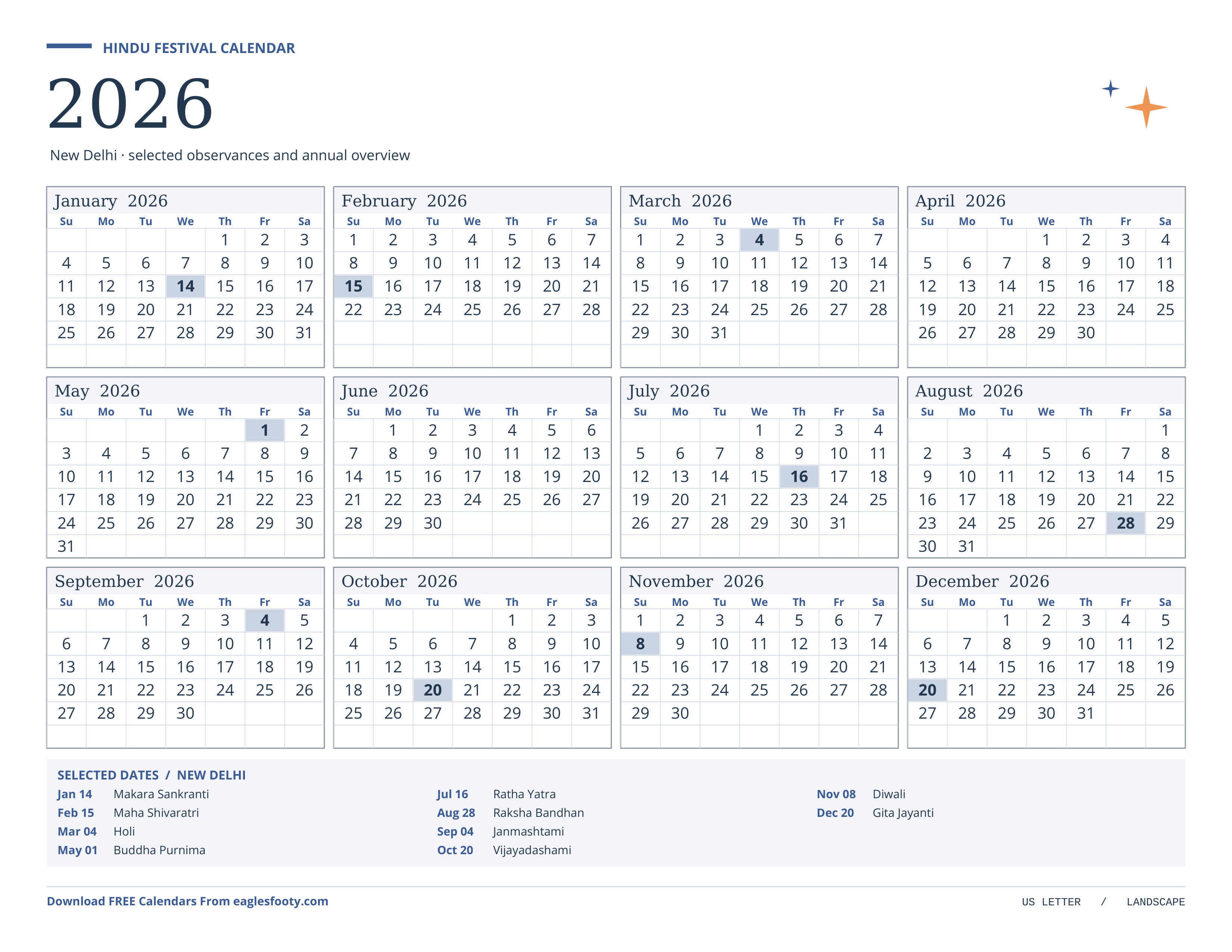
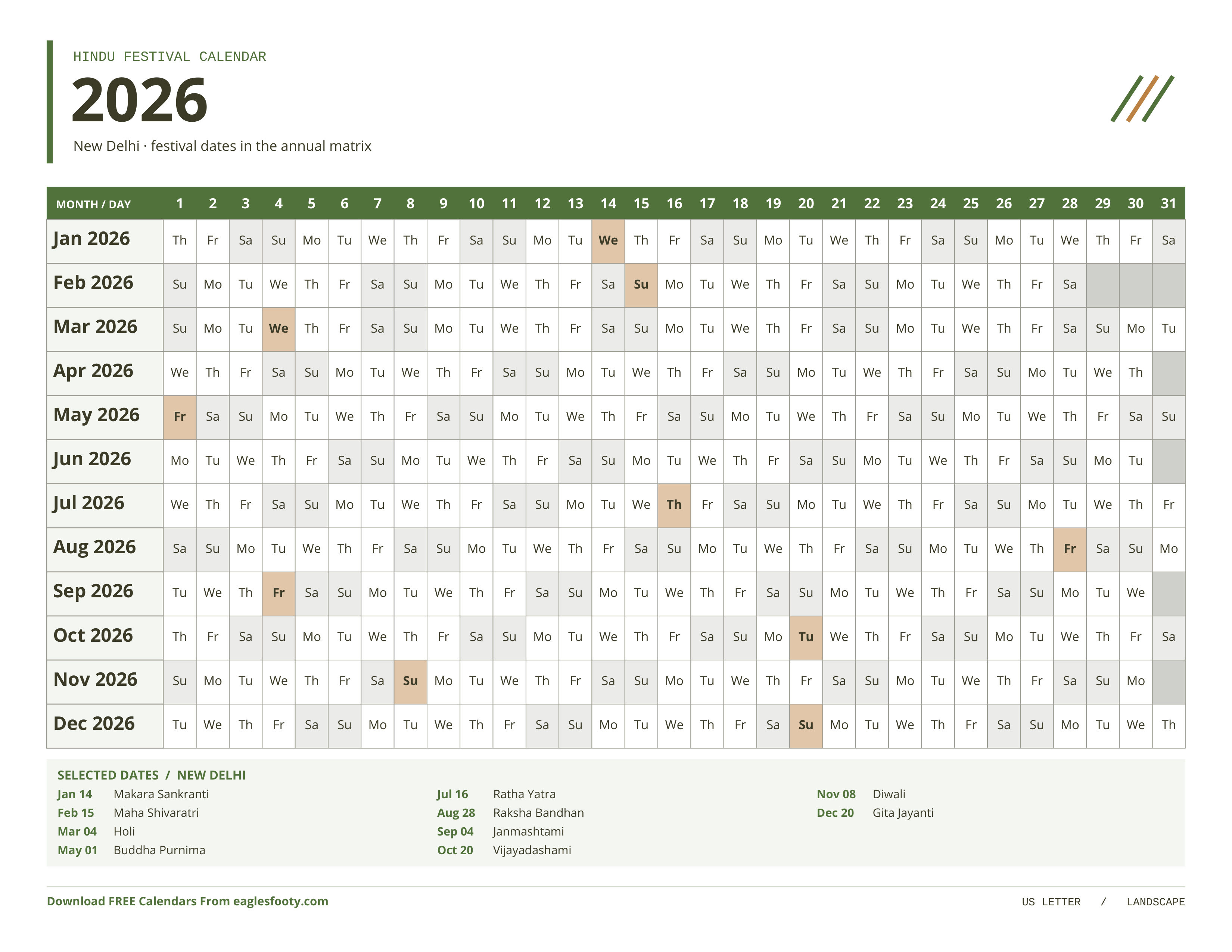
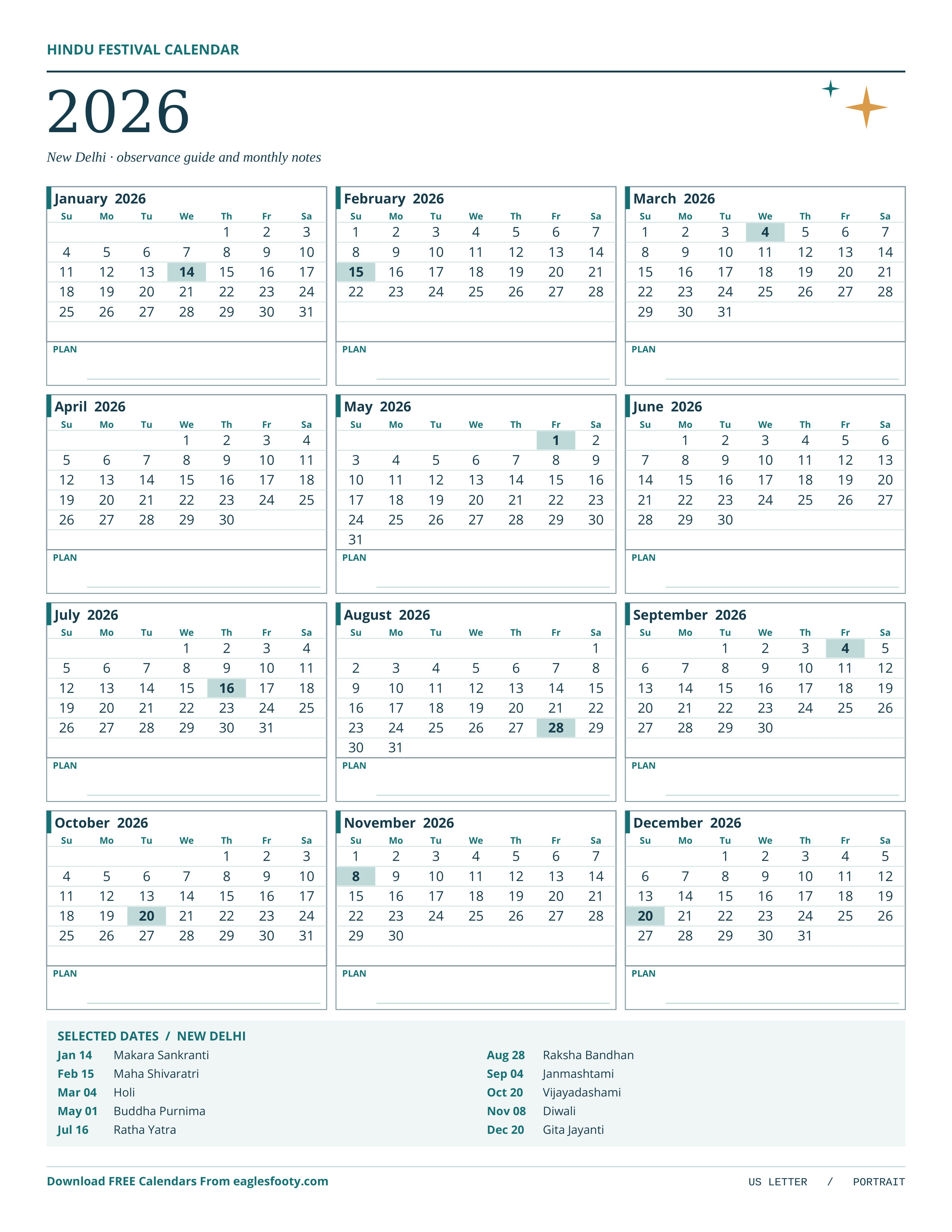
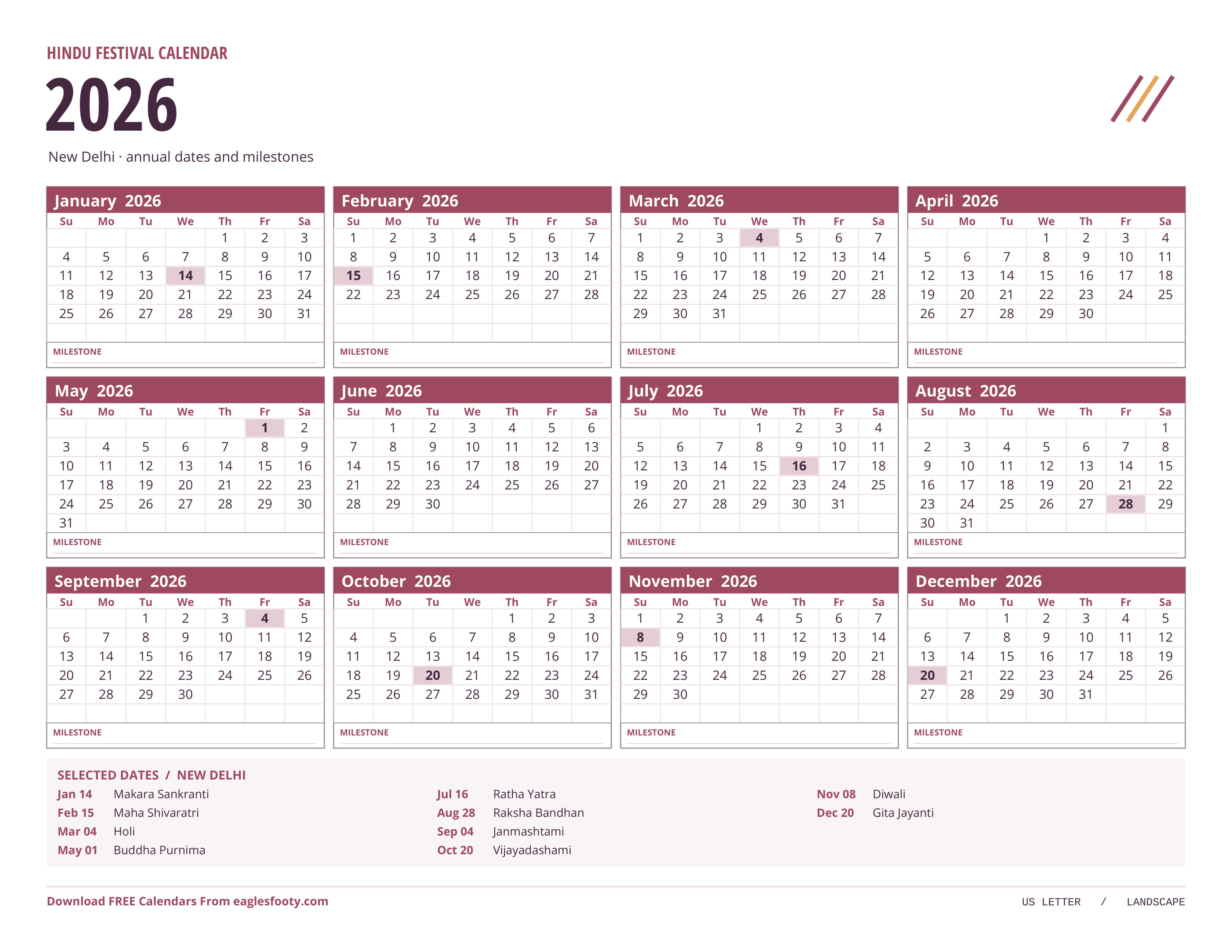
Hindu Calendar 2026 January to December shows the Gregorian year with selected Hindu festival dates calculated or listed for New Delhi, India. Holi falls on March 4, Raksha Bandhan on August 28, Vijayadashami on October 20, and Diwali on November 8. Use the annual view to see how the festival season fits alongside school and work, then check a local panchang when an observance depends on the time of day.
For December appointments alongside the year’s festivals, use the December 2026 Calendar collection.
Hindu Calendar 2026 January to December: All 12 Months
What a Hindu Festival Date Tells You
A civil calendar changes date at midnight. A tithi measures a particular separation between the Sun and Moon and can begin or end during the civil day. Festival rules may refer to the tithi at sunrise, at night, or during another interval. As a result, a published festival date is meaningful together with the place and tradition used to determine it. Write “New Delhi” on a family reference copied from this page.
Some observances follow a solar event. Makara Sankranti, for instance, marks the Sun’s entry into Makara in the traditional solar reckoning. A lunar festival such as Raksha Bandhan belongs to a different sequence. The two can appear in the same month panel because the grid indexes both against the Gregorian year. The printed positions are for 2026 and should be looked up again when preparing next year’s invitations.
Hindu Calendar 2026, January to December: Selected Festivals
| Date for New Delhi | Festival | A Detail to Carry Into Your Plan |
|---|---|---|
| Wednesday, January 14 | Makara Sankranti | Add the local name if your family marks the occasion under another spelling. |
| Sunday, February 15 | Maha Shivaratri | Check when the temple’s evening or overnight program begins. |
| Wednesday, March 4 | Holi | Ask whether a listed gathering is the daytime celebration or a separate event. |
| Friday, May 1 | Buddha Purnima | Record the observance your community is actually holding. |
| Friday, August 28 | Raksha Bandhan | Allow mailing time if family members live apart. |
| Friday, September 4 | Janmashtami | Add the host temple before copying any service time. |
| Tuesday, October 20 | Vijayadashami, or Dussehra | Compare the festival date with the public program announcement. |
| Sunday, November 8 | Diwali | Check the household or temple timetable for local worship. |
| Sunday, December 20 | Gita Jayanti | Add readings, classes, or gatherings at their advertised hours. |
Choosing Which Dates Belong on a Family Calendar
A long list can hide the occasions a household will attend in person. Choose one or two dates per season first. If an elder travels to visit family around Diwali, mark the arrival and departure days next to the festival. If a child’s class is holding a Holi activity, enter the school date as a distinct event. The year view will then show whether a hotel stay, school absence, or larger meal requires advance planning.
- Start with your family’s own list and circle the corresponding civil dates.
- Write the city beside each planned service and check that city’s current panchang.
- Add school and work commitments in the spaces surrounding the main occasion.
- When an organizer confirms the time, transfer that detail to the monthly appointment calendar.
A useful shorthand for a shared family sheet is “Delhi date,” “local service,” and “our meal.” Each phrase answers a question someone might ask when all three fall in the same week. It also gives you a place for weekend celebrations arranged for convenience. A cultural association can choose a Saturday afternoon for a program even when the listed religious observance takes place on a weekday.
Why Month Names Can Differ
North Indian and other regional almanacs can organize lunar months using different boundaries. One scheme ends a month at the full moon and another at the new moon. A difference in the printed month name does not by itself establish a disagreement about when a family should attend an event. Compare the city, festival name, date, and applicable tradition together. For a ritual timed to a particular interval, follow the local organizer’s guidance directly.
- Keep the full festival name on invitations that a mixed audience will receive.
- Include a physical address or time zone whenever relatives can attend remotely.
- Use a distinct mark for a government closure and for a private celebration.
- Leave the exact ritual time blank until a source for the relevant location provides it.
Printing a Year That Stays Useful
On a Hindu calendar for January to December 2026, a small mark for the festival and a second mark for the family gathering can answer two different questions at a glance.
A large annual view belongs where people can read a month name without touching the page. Before mounting it, look at September and November from the distance at which your family normally stands. If the small entries are hard to read, display the annual view for dates and keep the detailed program near the household calendar. This avoids trying to squeeze a long service schedule into one square.
For a school display, invite students or families to add the names and customs they actually use. A single observance can carry different regional names, and some families will mark other dates altogether. That practice gives the class a more accurate guide to its own community. The New Delhi Hindu festival calendar gives the local religious listings, and the New Delhi government office calendar identifies gazetted and restricted holidays.