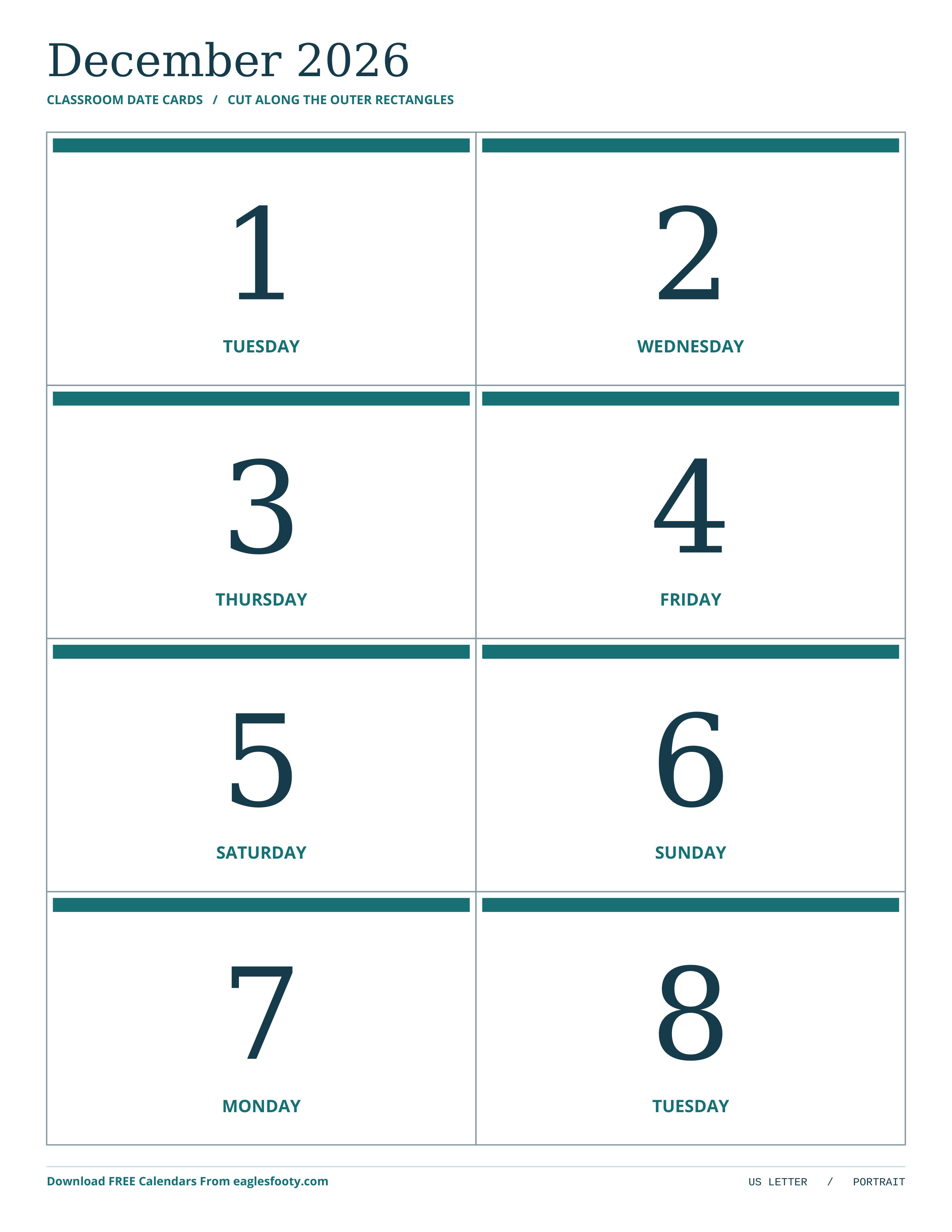
December 2026 Calendar Numbers Printable sets give you individual date cards for a classroom pocket chart, a bulletin board, or a calendar activity at home. Use the packet for complete sets numbered 1 through 31. The cards print eight to a page, with space at the end of each set after number 31. December 1 falls on Tuesday, which determines where the first card belongs on your board.
To check the order of the cards against a complete month, see the December 2026 Calendar Printable collection.
December 2026 Calendar Numbers Printable: Date Cards
Set Up Your December 2026 Calendar Numbers Printable
Decide whether Sunday or Monday will be the first column before placing any cards. The dates work with either convention as long as the weekday labels and positions match. On a Sunday-first board, leave Sunday and Monday open before setting down Tuesday’s 1. On a Monday-first board, leave just Monday open. Both boards finish the month on Thursday the 31st.
| Set of Cards | Numbers to Find | A Quick Check |
|---|---|---|
| First sheet in a set | 1–8 | Tuesday the 1st is followed one week later by Tuesday the 8th. |
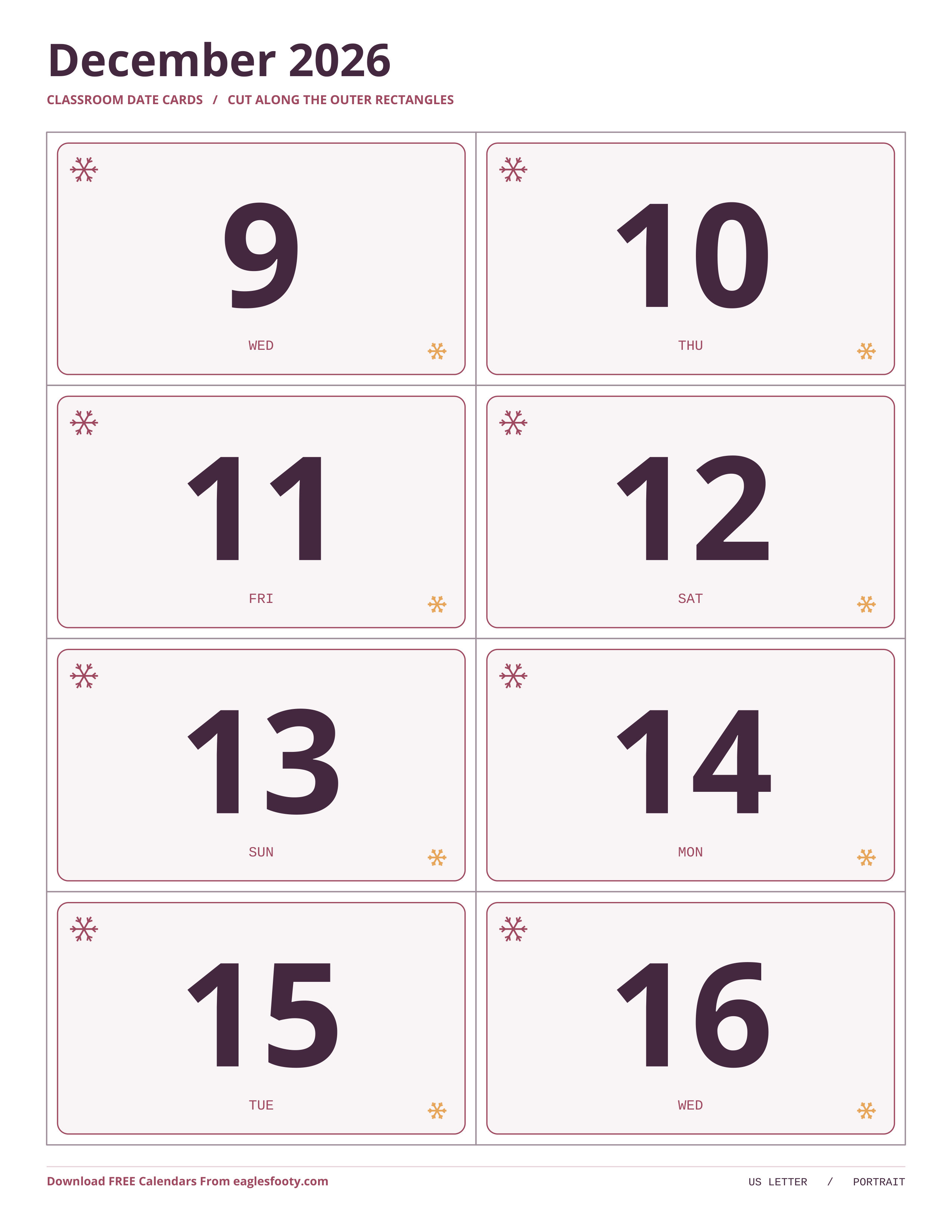
| Second sheet | 9–16 | Wednesday the 9th and Wednesday the 16th share a column. |
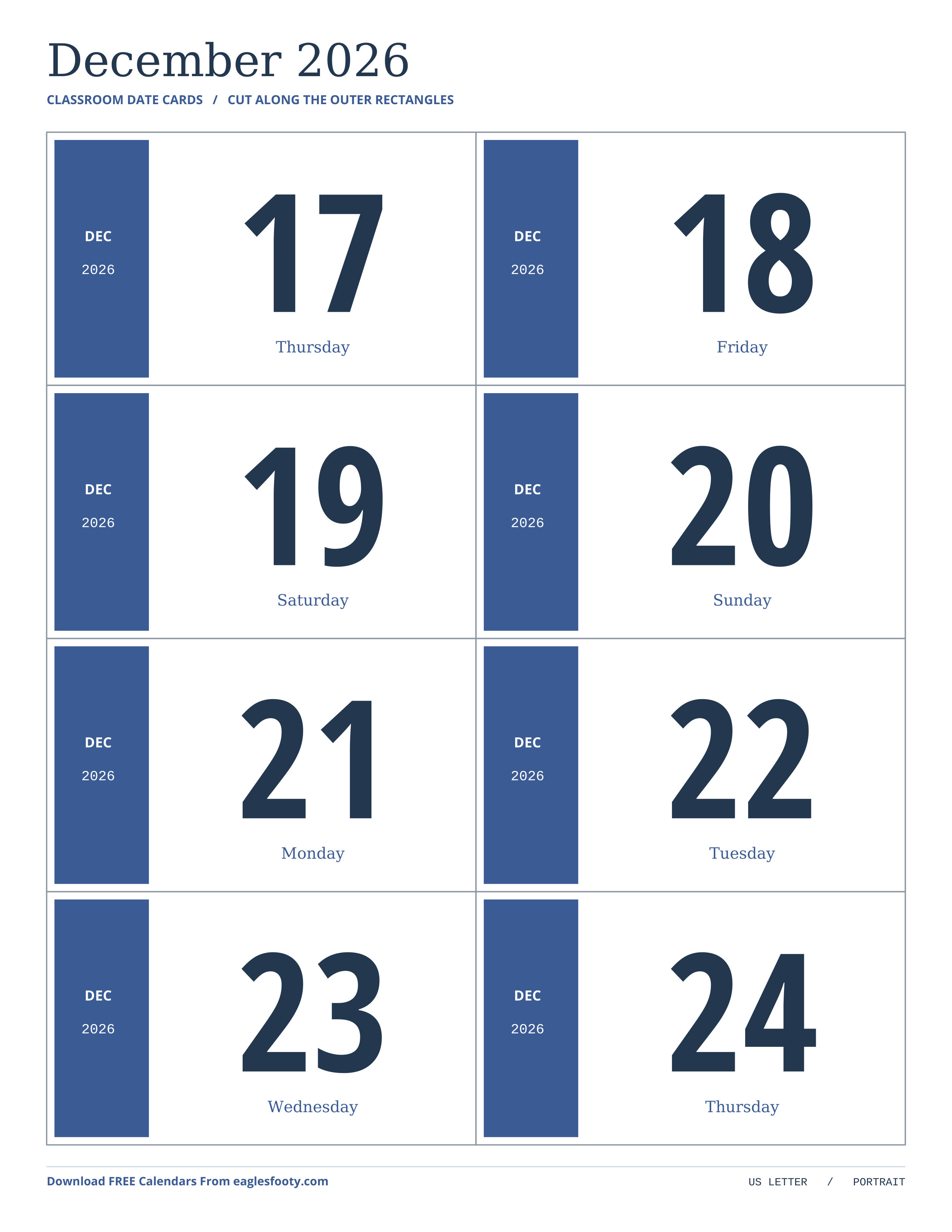
| Third sheet | 17–24 | Thursday the 17th and Thursday the 24th sit one row apart. |
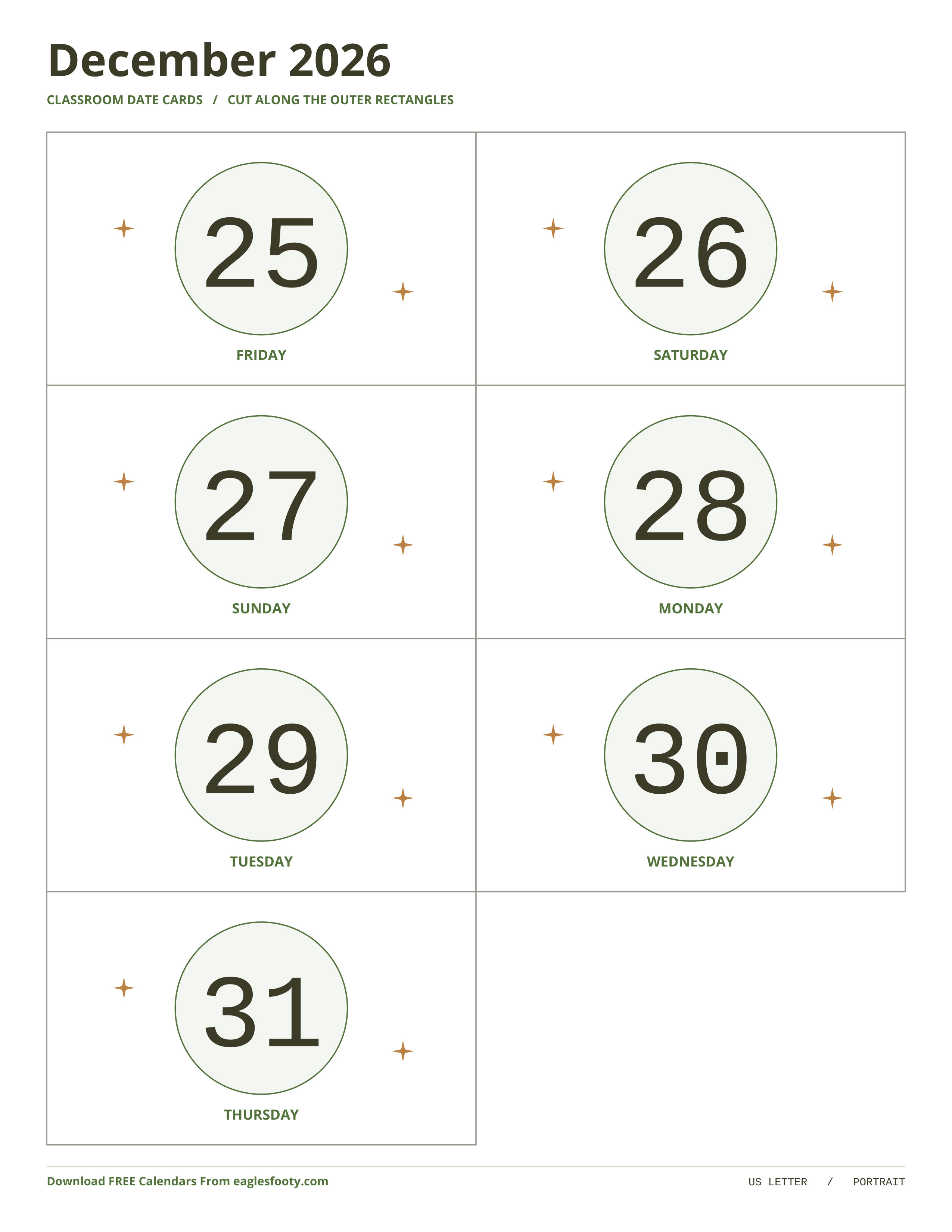
| Fourth sheet | 25–31 | Place the final 31 under Thursday. |
The PDF groups 16 pages into complete sets of one style. The sample images show a different number range in each style, which is helpful for comparing the serif numerals, snowflake cards, high-contrast side tabs, and star medallions. For a uniform month, print the matching pages from the same section of the PDF.
Sizing a December 2026 Calendar Numbers Printable for a Pocket Chart
Pocket charts differ in pocket depth and slot width. Print one sample page and cut a card along its rectangular boundary. Slip it into a corner pocket and a center pocket. The numeral should remain visible above the lip, and the card should lift out without bending. For a board with no pockets, check whether you have enough width for seven cards with a little space between them.
If the cards are too large, reduce the print scale and repeat the test using the same page. Print the remaining pages with exactly the same settings so the edges line up. If you need a larger number than the existing pocket can show, a board with wider spaces may work better than shrinking a bold numeral into a very narrow opening.
Assemble a Month Children Can Build
- Choose one visual style in the PDF and print the complete numbered set from that section.
- Cut the cards along the outlines and place them face up in rough groups of ten.
- Add the weekday labels across the top of the board, then position card 1 below Tuesday.
- Fill the rows one day at a time, or set out the entire month and use a movable marker for today.
For a first calendar activity, lay out just the opening dates rather than asking children to sort a pile of 31 at once. Place 1 under Tuesday and ask what comes next. After several cards, point to Saturday and show how the next number moves to the start of the following row on a Sunday-first board. This short exercise connects counting to the physical shape of a calendar.
Try Three Different Date-Card Games
- Hide one number in an otherwise complete week and ask learners to use both neighbors to identify it.
- Put one Tuesday in place and find the Tuesday exactly one week later by counting seven days.
- Give a small group the dates for one row and let them check their order against the weekday headings.
A useful follow-up is to change one variable at a time. Keep the week in order but turn over Thursday’s card. Ask which number is missing and how the group knows. Next, move a correctly numbered card into the wrong weekday column. A child who can explain why the position feels wrong is practicing something more specific than reciting a number sequence.
Use the Cards Beyond Morning Calendar Time
At home, set the cards on a table in dated order for a simple countdown. Move a small marker to today’s card rather than removing every past date. Yesterday and tomorrow stay visible, so you can talk about them in relation to today. If a family visit is on December 20, ask how many daily moves remain and count together without covering the numbers.
For a class event, give special dates an adjacent label or a separate marker. Write “library visit” on a small strip placed below the date, for example. Keeping the original numeral uncovered helps learners match the spoken date to the number. It also lets you reuse the same cards for a sequencing game after the event has passed.
Store the Set So Missing Numbers Are Obvious
Before packing up, separate 1–10, 11–20, 21–30, and the single 31. Say each run aloud or check it against a list, then stack the groups in order. Put the finished set in an envelope labeled with its visual style and the scale you printed. If you lose a card, you can locate the right part of the original PDF and make a replacement that matches the rest.
For repeated classroom use, keep a master print uncut or save the PDF where colleagues can find it. Write a small set mark on the backs if several teachers use different styles. This makes it much easier to sort loose cards after a busy activity and to start the next day’s calendar with every number in its place.