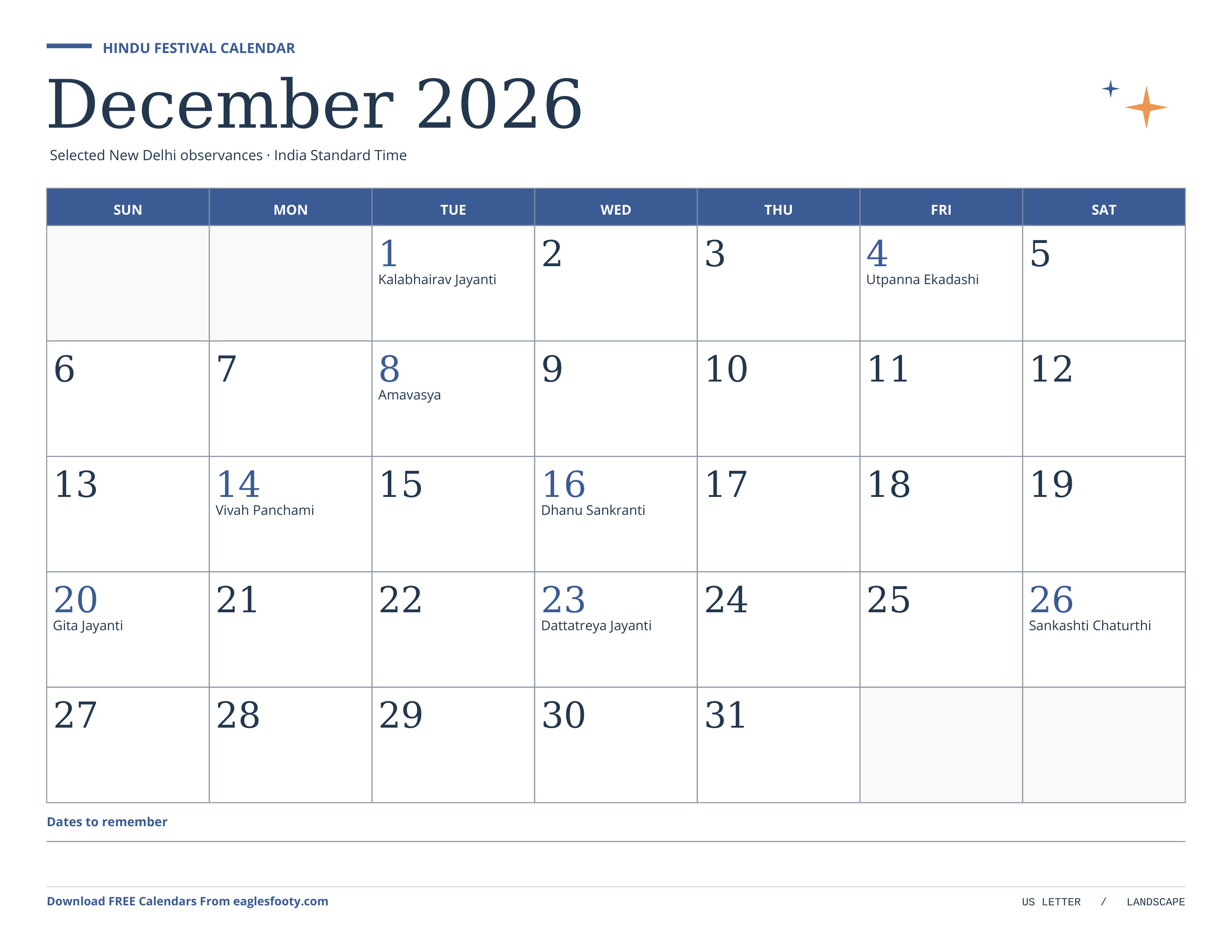
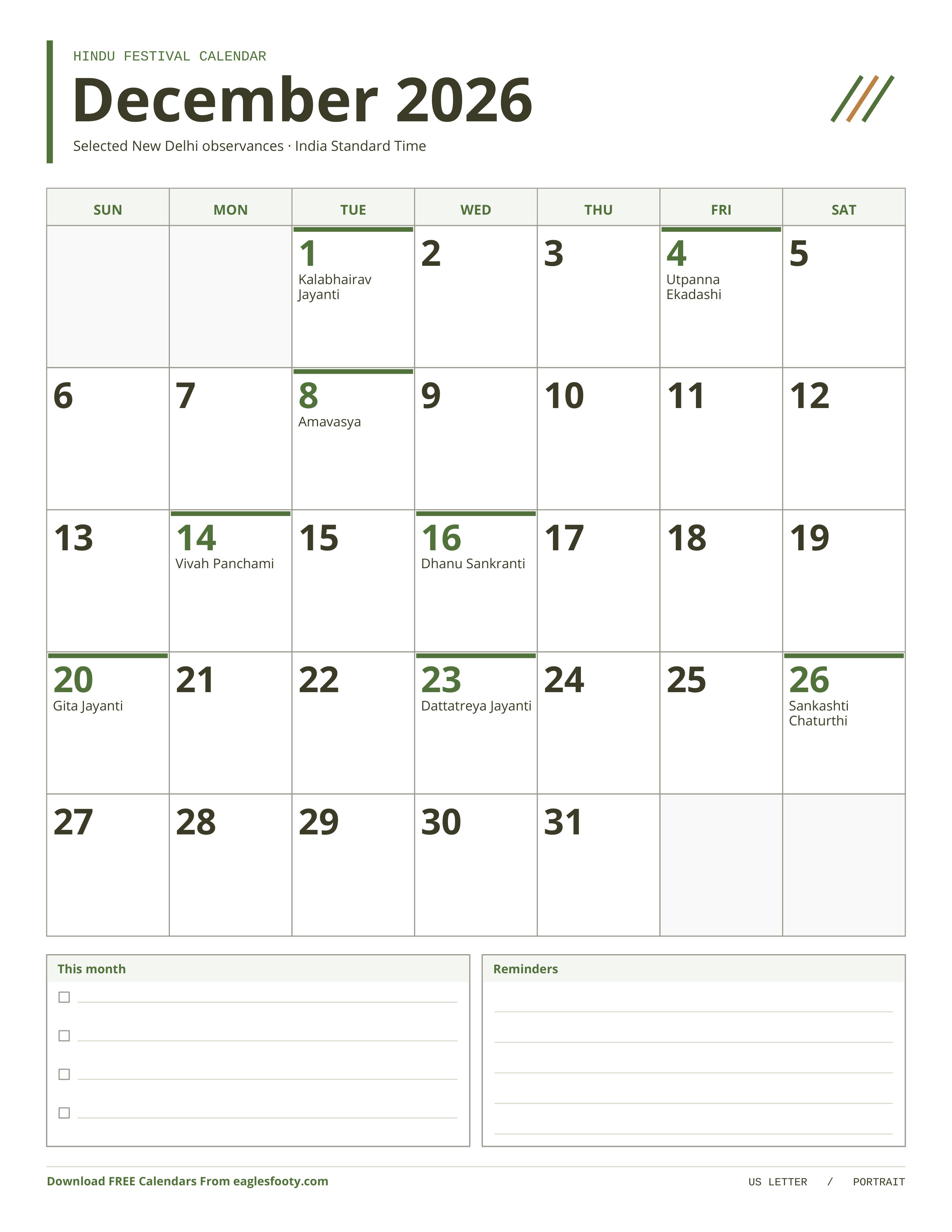
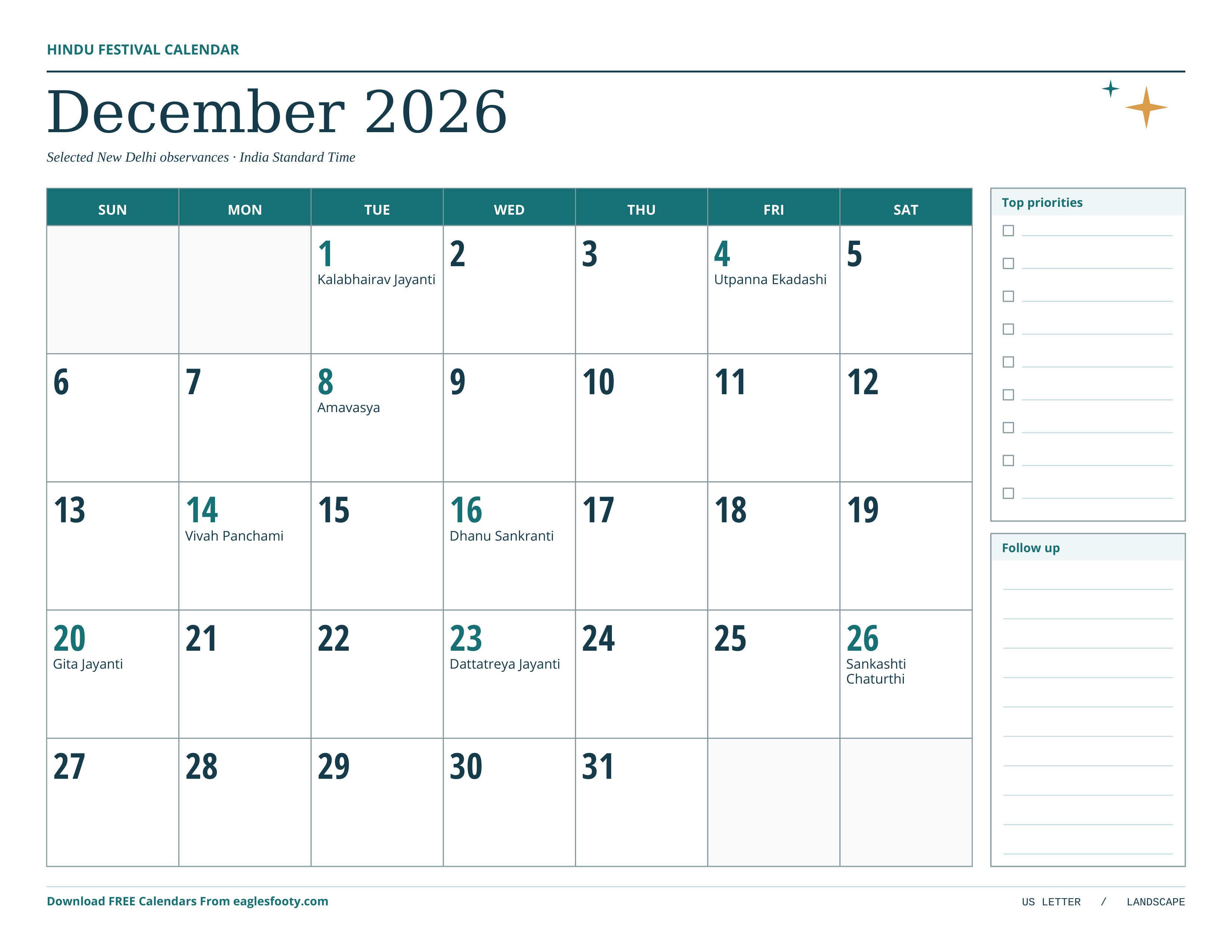
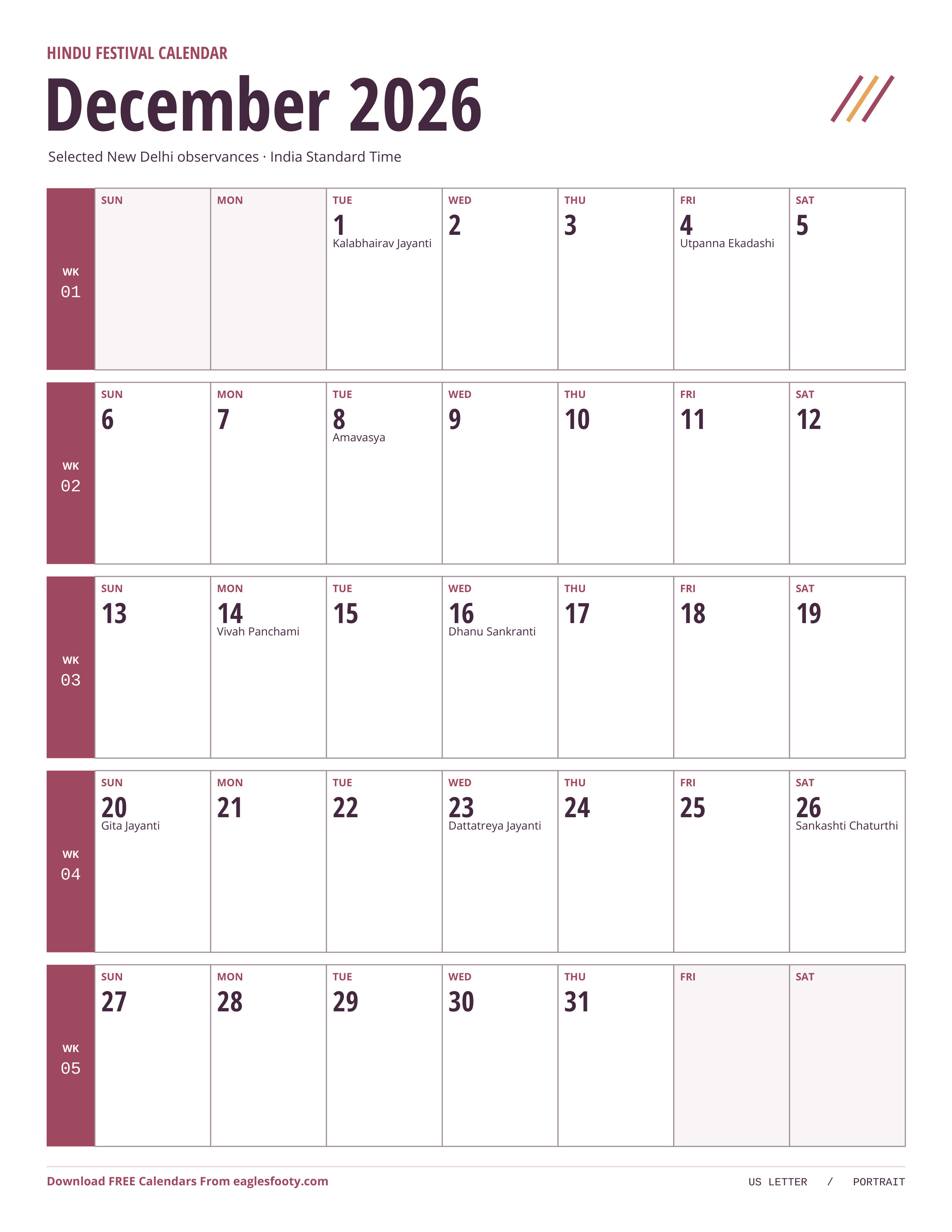
Hindu Calendar 2026 December lists selected observances for New Delhi, India, including Utpanna Ekadashi on Friday, December 4, Dhanu Sankranti on Wednesday, December 16, Gita Jayanti on Sunday, December 20, and Dattatreya Jayanti on Wednesday, December 23. The monthly format gives you space to record local temple programs or family gatherings alongside those reference dates.
For a civil month sheet to share alongside the festival list, use the December 2026 Calendar collection.
Hindu Calendar 2026 December: Festival Calendar
Hindu Calendar 2026: December Festivals in New Delhi
A festival list works better when it identifies why a date is marked. Some entries refer to a lunar day, known as a tithi. Others follow a solar transition. Gita Jayanti falls on the bright-half Ekadashi of Margashirsha in the New Delhi listing. Dhanu Sankranti marks a change in the Sun’s position in the traditional solar system. Knowing this distinction helps when a household consults a panchang that prints many different symbols in one square.
| Date in New Delhi | Observance | A Note for Reading the Month |
|---|---|---|
| Tuesday, December 1 | Kalabhairav Jayanti | An observance associated with Krishna Ashtami. |
| Friday, December 4 | Utpanna Ekadashi | This is the earlier of the two marked Ekadashis. |
| Tuesday, December 8 | Amavasya | The listing identifies a new-moon lunar observance. |
| Monday, December 14 | Vivah Panchami | Find it in the bright half of the lunar month. |
| Wednesday, December 16 | Dhanu Sankranti | This marker follows a solar transition. |
| Sunday, December 20 | Gita Jayanti and Mokshada Ekadashi | Two observance names share this Gregorian date. |
| Wednesday, December 23 | Dattatreya Jayanti | The local calendar also lists Margashirsha Purnima observances. |
| Saturday, December 26 | Akhuratha Sankashti Chaturthi | Ask for local timings when an observance depends on moonrise. |
Why Two Days Called Ekadashi Appear
Ekadashi is the eleventh tithi in a lunar fortnight. A dark half and a bright half each contain an eleventh tithi. In this December listing, Utpanna Ekadashi falls early in the civil month and Mokshada Ekadashi falls on December 20. If an invitation says only “Ekadashi program,” the host’s full name for the observance will help you choose the correct box before you add a time.
The calendar date is only one part of the information a person following a religious practice may need. Local panchangs can give the beginning or end of a tithi and a time for a particular rite. Those intervals depend on a combination of the convention and the location. A monthly sheet with a Gregorian date leaves that space for the temple or household to complete using its own source.
Preparing for a Gita Jayanti Reading
A group reading planned for Sunday, December 20, needs more than a highlighted date. Choose the host, the gathering time, and the text or language the group will use. If different participants will read different passages, give each reader a copy of the final sequence. A participant joining from the United States needs the time in the host city and their own city, especially when the event falls early in the Indian morning.
- Write the festival name and New Delhi reference date on the month grid.
- Confirm whether the local host is following that date or holding a community program on another day.
- Record the gathering time, expected end, and the name of the person managing remote access.
- Send the same dated notice to in-person and online participants so everyone works from one schedule.
A family meal later that evening can have its own short entry. This avoids moving a worship service when only the meal time changes. For an online reading, add the organizer’s contact outside the day cell so it remains legible. Keep the instructions for joining private if the event is open only to invited relatives.
Working With More Than One Panchang
- Check the selected city on any website that calculates festival dates.
- Identify whether a time refers to the tithi, a temple service, or a community meal.
- Write the local time zone beside a livestream and check which civil day it reaches abroad.
- Keep alternate regional spellings together when they refer to the same event.
At the end of December, a North Indian list may show Pausha beginning in the dark fortnight after the full moon. A person using a different lunar month convention can encounter a different month heading for part of the same period. The festival’s named tithi and the local observance rules offer a better starting point for comparison than trying to align month headings alone.
Choosing a Date for a US Gathering
Use a pencil for US program times on the December Hindu calendar for 2026 until the temple shares its itinerary. The festival date alone cannot tell you when a public reading begins.
If you live in the United States, treat the New Delhi entries as a reference for communication with people in India. A US temple may publish a local date according to its tradition and location. Ask the temple which date it uses for the observance and which date it offers a public program. Record both if necessary. That makes it possible to send greetings to family in New Delhi and still arrive at the correct local service.
For a permanent family calendar, save the source city and year with the printed page. Older notes can be helpful for remembering who hosted an occasion, but lunar festival dates need a fresh lookup in each civil year. Consult the New Delhi December festival listing from Drik Panchang when adding other observances to the month.