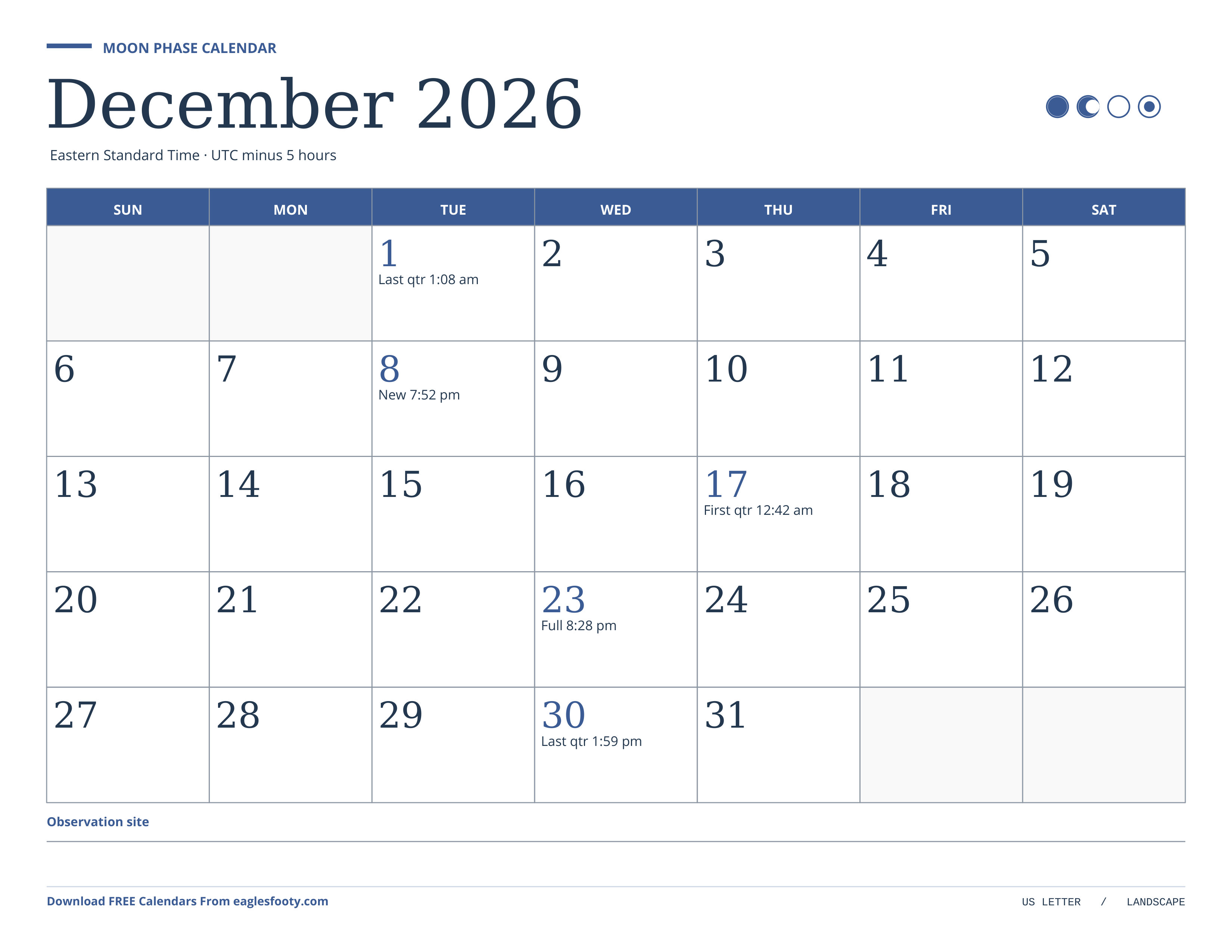
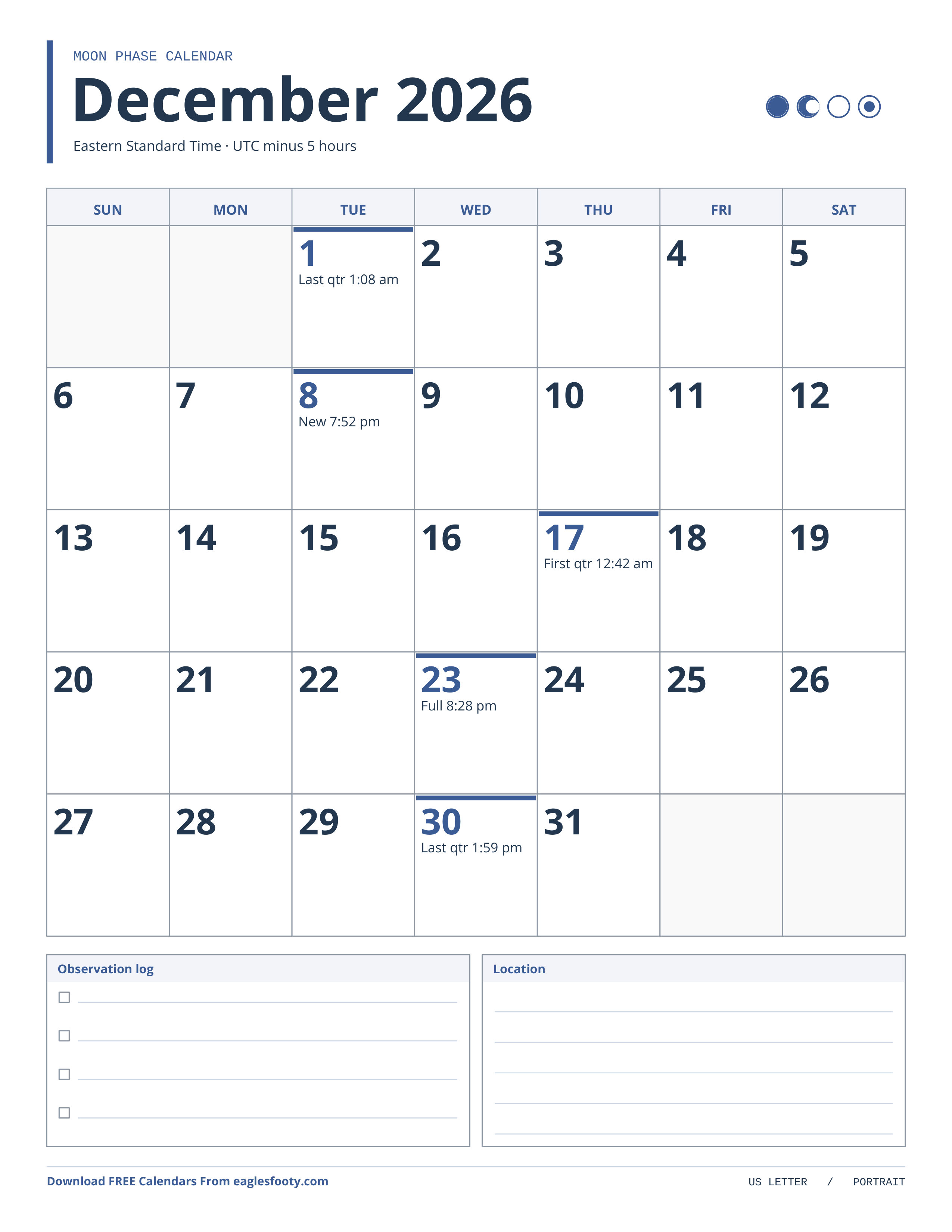
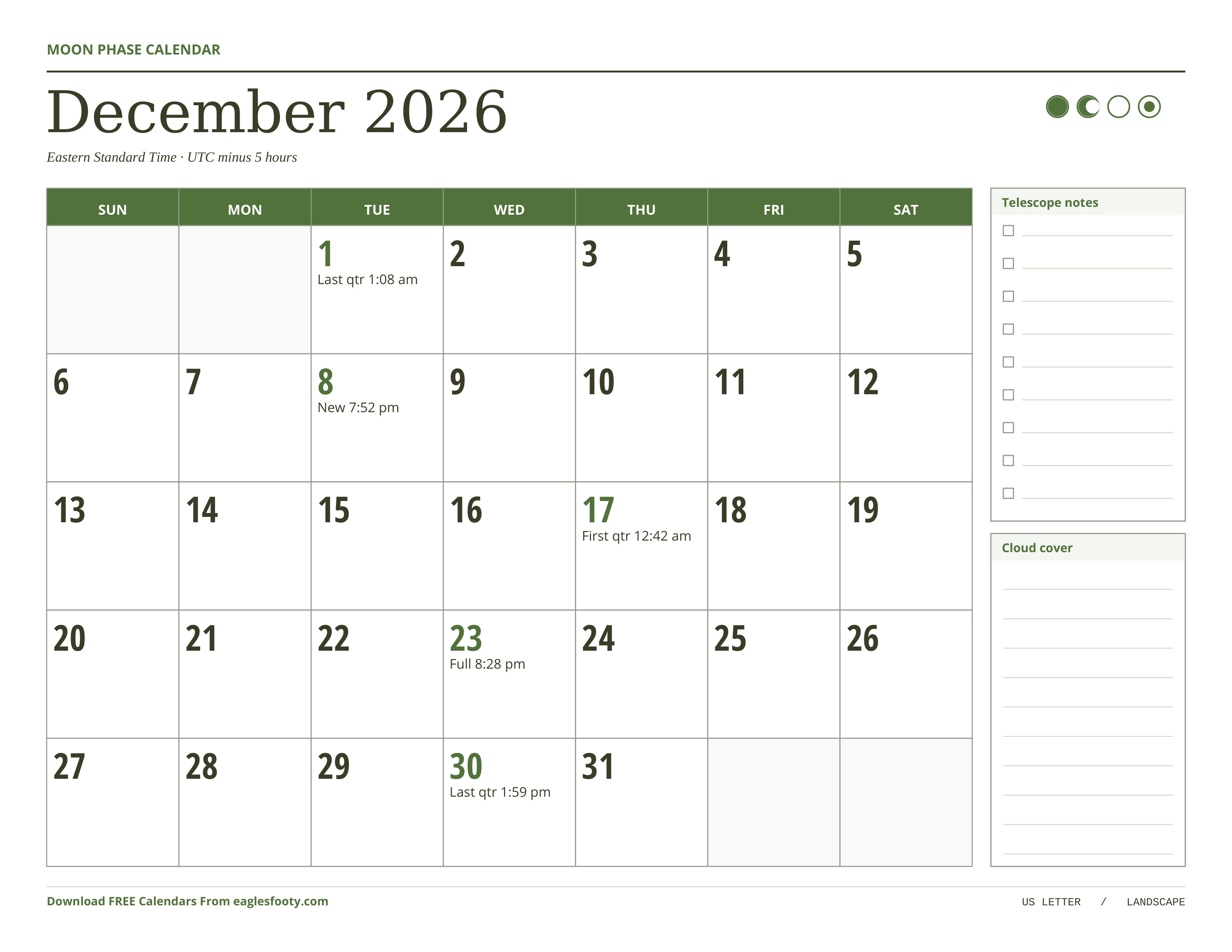
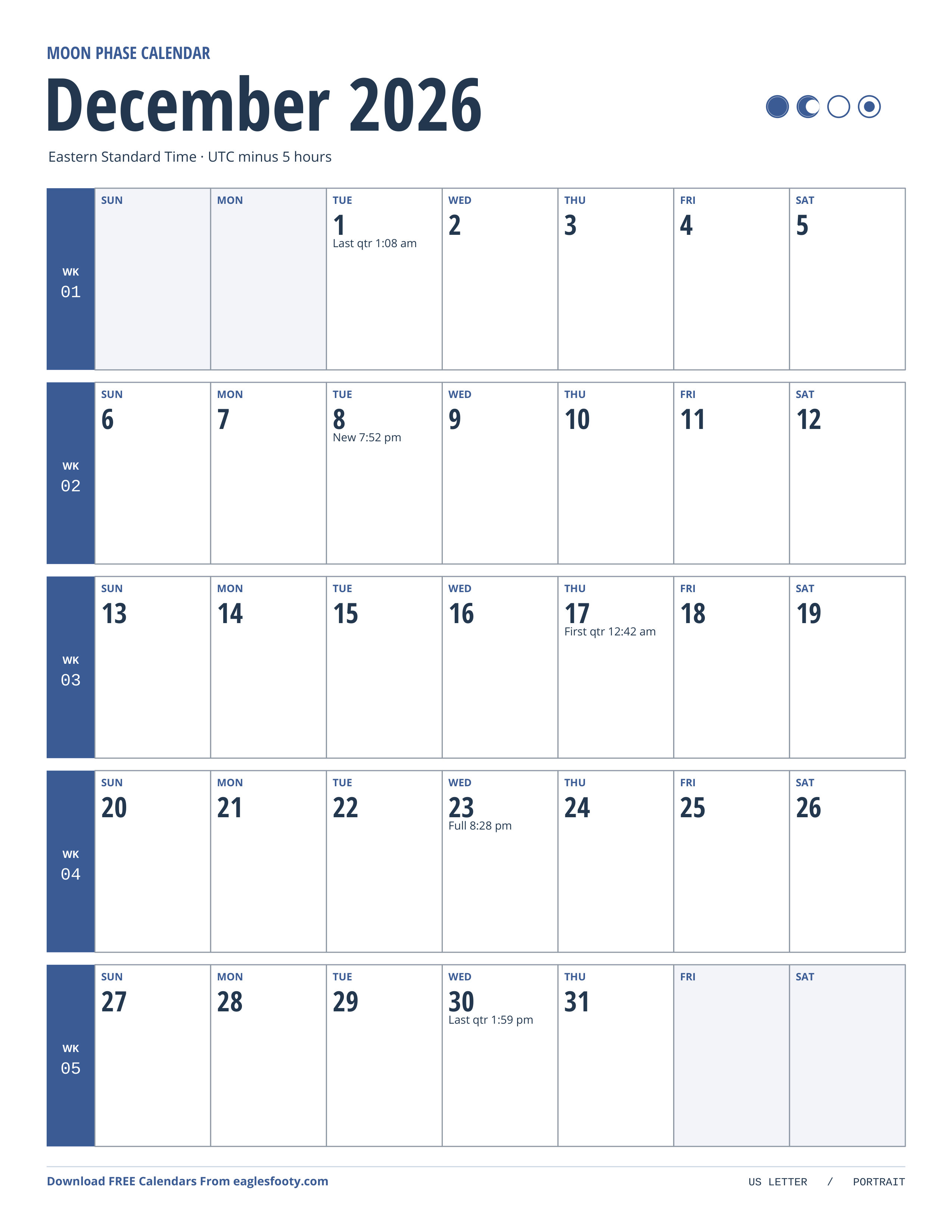
December 2026 Moon Calendar places the new Moon on Tuesday, December 8, and the full Moon on Wednesday, December 23, in US Eastern Standard Time. There are two last-quarter phases on the Eastern calendar this month. The first occurs on December 1 and the second on December 30. Use the table to compare the date for your location before planning an evening outdoors.
To add a viewing night to an ordinary family schedule, open the December 2026 Calendar collection.
December 2026 Moon Calendar for Monthly Phase Tracking
December 2026 Moon Phases by Time Zone
The US Naval Observatory publishes the primary phases in Universal Time. The same phase occurs at one instant worldwide, while the date on a local clock varies. The December 24 full Moon listed in Universal Time happens during the evening of December 23 in New York and Los Angeles. In the table below, each column gives the local civil date as well as the clock time so a conversion across midnight is visible.
| Phase | Universal Time | New York, EST | Los Angeles, PST |
|---|---|---|---|
| Last Quarter | December 1, 06:08 | December 1, 1:08 a.m. | November 30, 10:08 p.m. |
| New Moon | December 9, 00:52 | December 8, 7:52 p.m. | December 8, 4:52 p.m. |
| First Quarter | December 17, 05:42 | December 17, 12:42 a.m. | December 16, 9:42 p.m. |
| Full Moon | December 24, 01:28 | December 23, 8:28 p.m. | December 23, 5:28 p.m. |
| Last Quarter | December 30, 18:59 | December 30, 1:59 p.m. | December 30, 10:59 a.m. |
Why an Eastern Month Shows Five Phase Markers
The lunar cycle takes about twenty-nine and a half days. A civil month can contain the same named phase near both ends. On an Eastern calendar, December opens just before an early-morning last quarter and contains another late in the month. On a Pacific calendar, the first of these instants belongs to November 30. Both records are consistent with the same astronomical calculation.
If your family lives in a different US zone, work from the Universal Time column using the offset in effect in your location that day. Write out the resulting weekday and date before copying the time onto the schedule. For instance, subtracting eight hours from 05:42 produces a time on the previous evening in Los Angeles. Keeping the original date beside the subtraction is an easy way to catch that boundary.
What You Can See From the Ground
A phase time does not tell you when the Moon will rise over your horizon. Moonrise and moonset vary with the observer’s location, and a nearby hill or building can hide the Moon after its listed rise time. Use the local horizon and weather forecast when deciding where to set up. If the Moon is below the horizon at the precise full-phase instant, look when it comes into view that night.
The Moon appears bright because sunlight reflects from its surface. As it travels around Earth, we see different portions of its sunlit half. Around first quarter, the disk looks roughly half illuminated and often makes a convenient evening target. Around last quarter, try looking in the morning. New Moon sits near the Sun in the sky and is generally unsuitable for an ordinary visual Moon sketch.
A Simple Observation Series
- Choose a location with a repeatable reference, such as a rooftop or a tree line, and record the city.
- Pick several evenings across the month and write the actual observation time in local time.
- Draw the illuminated outline and mark its position relative to the feature you chose.
- Add a weather note, including an entry when clouds prevent you from seeing the Moon.
For a child’s notebook, use the word “observed” beside a sketch and “predicted” beside a phase date. A drawing made at 7 p.m. on December 22 records a real view even though the exact full Moon is the following evening. Comparing those two entries teaches the difference between a calendar calculation and a personal observation without making the child stay awake for a particular minute.
Using a December 2026 Moon Calendar for Photographs
- Save the date, local clock time, and location alongside the image.
- Mention whether the Moon was rising, high above the horizon, or setting if you know its position.
- Keep the original camera timestamp when editing a photo after midnight.
- Use the same foreground object for a short sequence if you want to compare positions.
Planning Around the December Full Moon
For an evening outing on December 23, check your city’s moonrise in addition to the 8:28 p.m. Eastern phase time. Choose a meeting hour that works for people and the actual view. An unobstructed horizon can matter more to the group than arriving at the exact instant of full phase. Put a second observation slot on the following evening in case of clouds.
A calendar shared across time zones needs the zone printed next to its phase dates. If a relative in California sends a November 30 last-quarter photo, it can belong to the same phase you marked December 1 in New York. Keep both local labels with the shared record. The numerical predictions come from the US Naval Observatory phase table, and NASA’s Moon phase guide illustrates the changing viewing geometry.