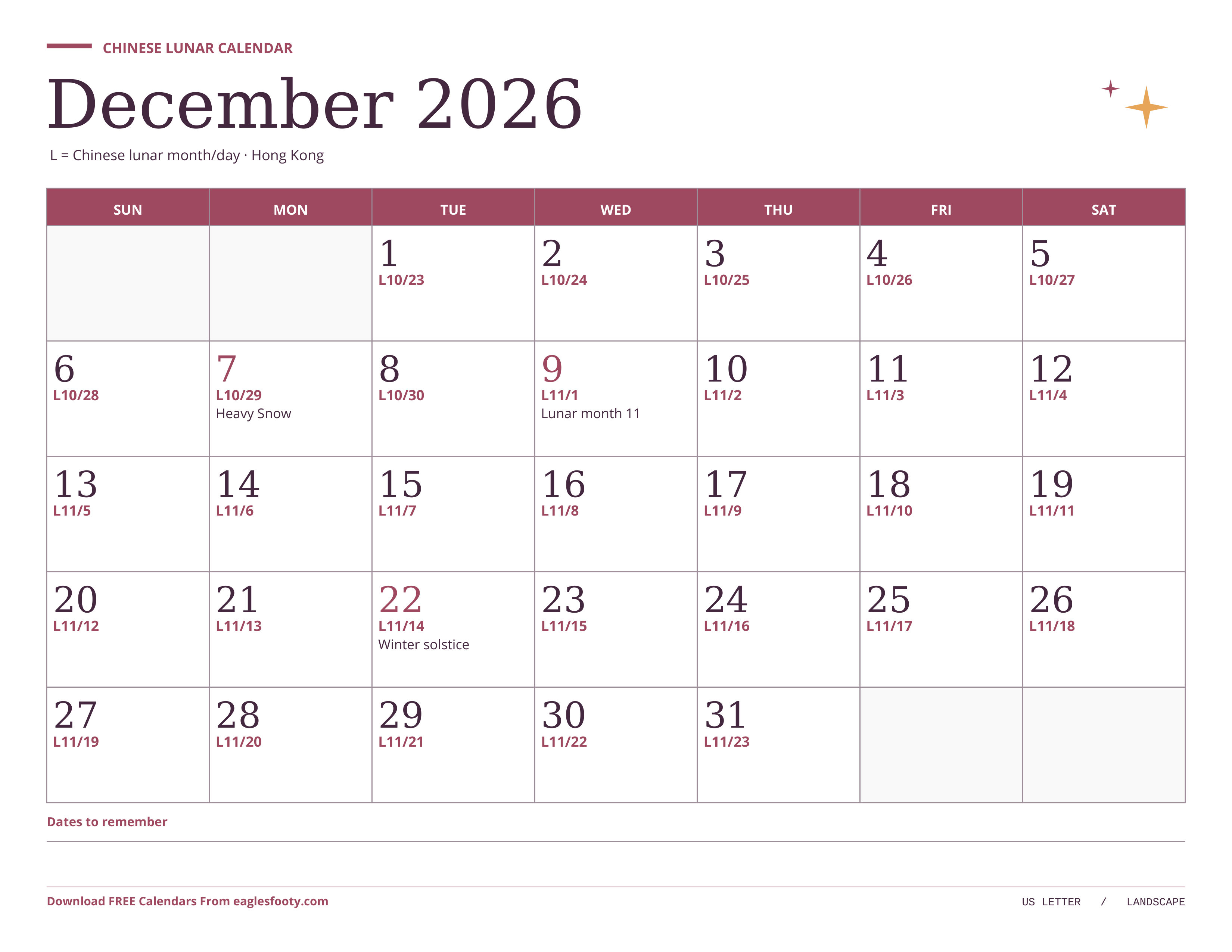
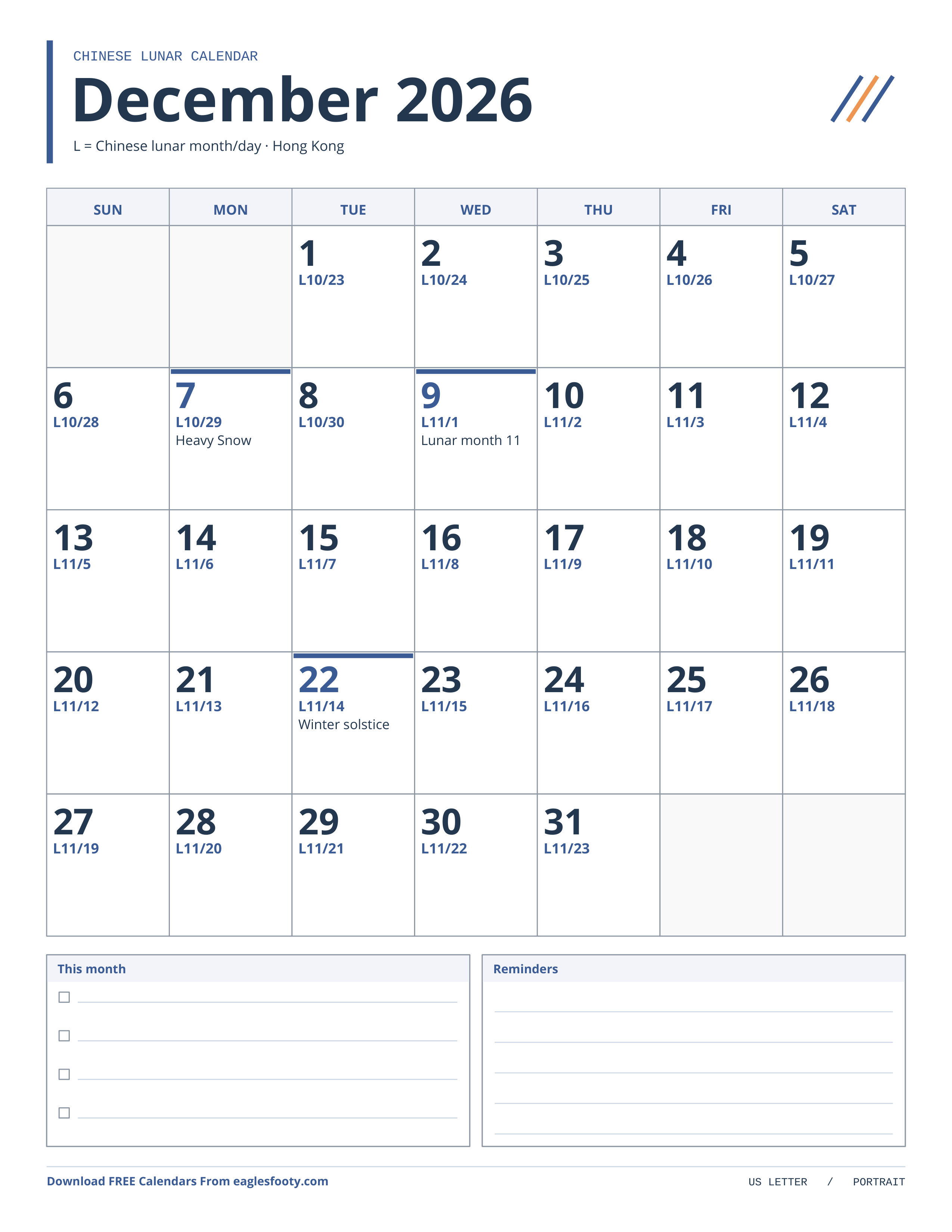
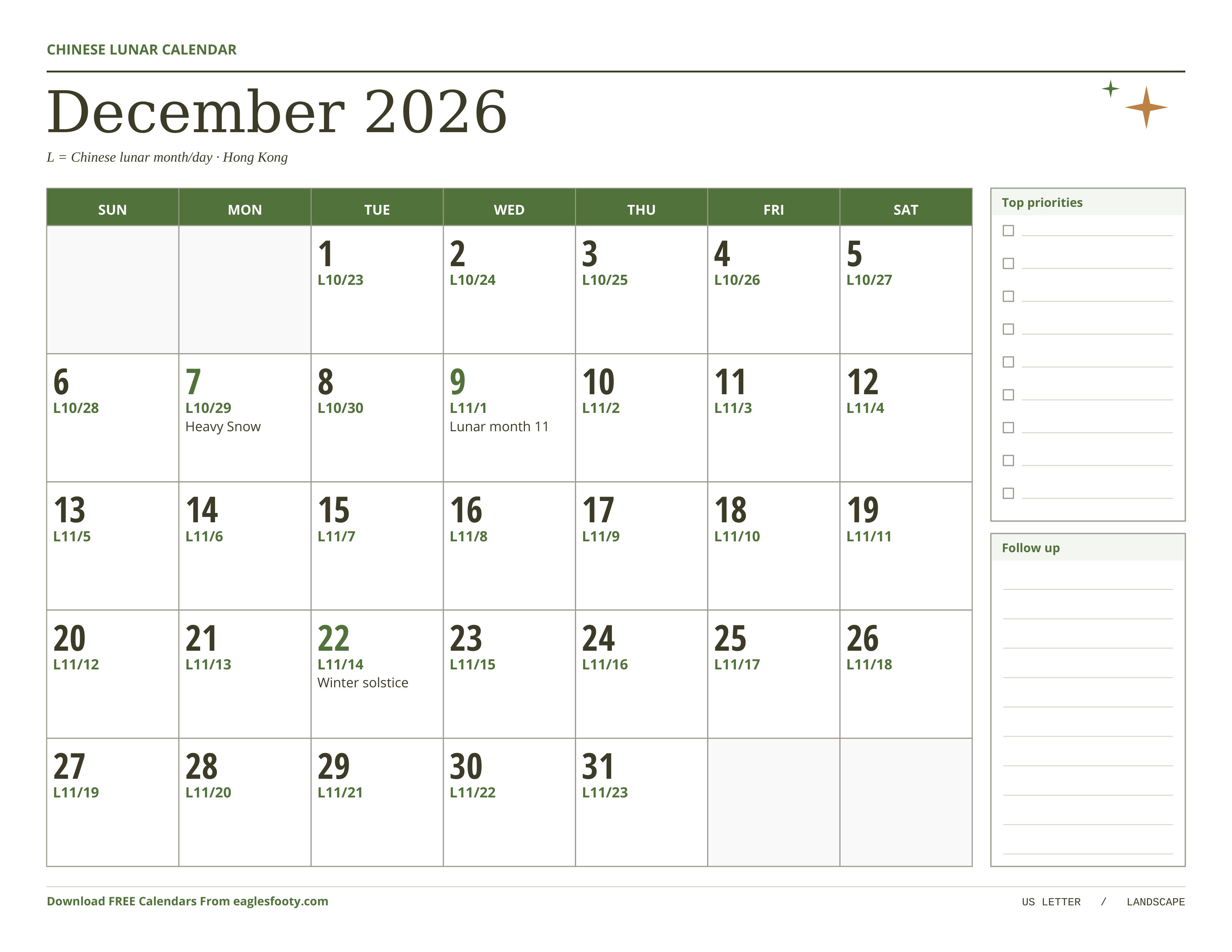
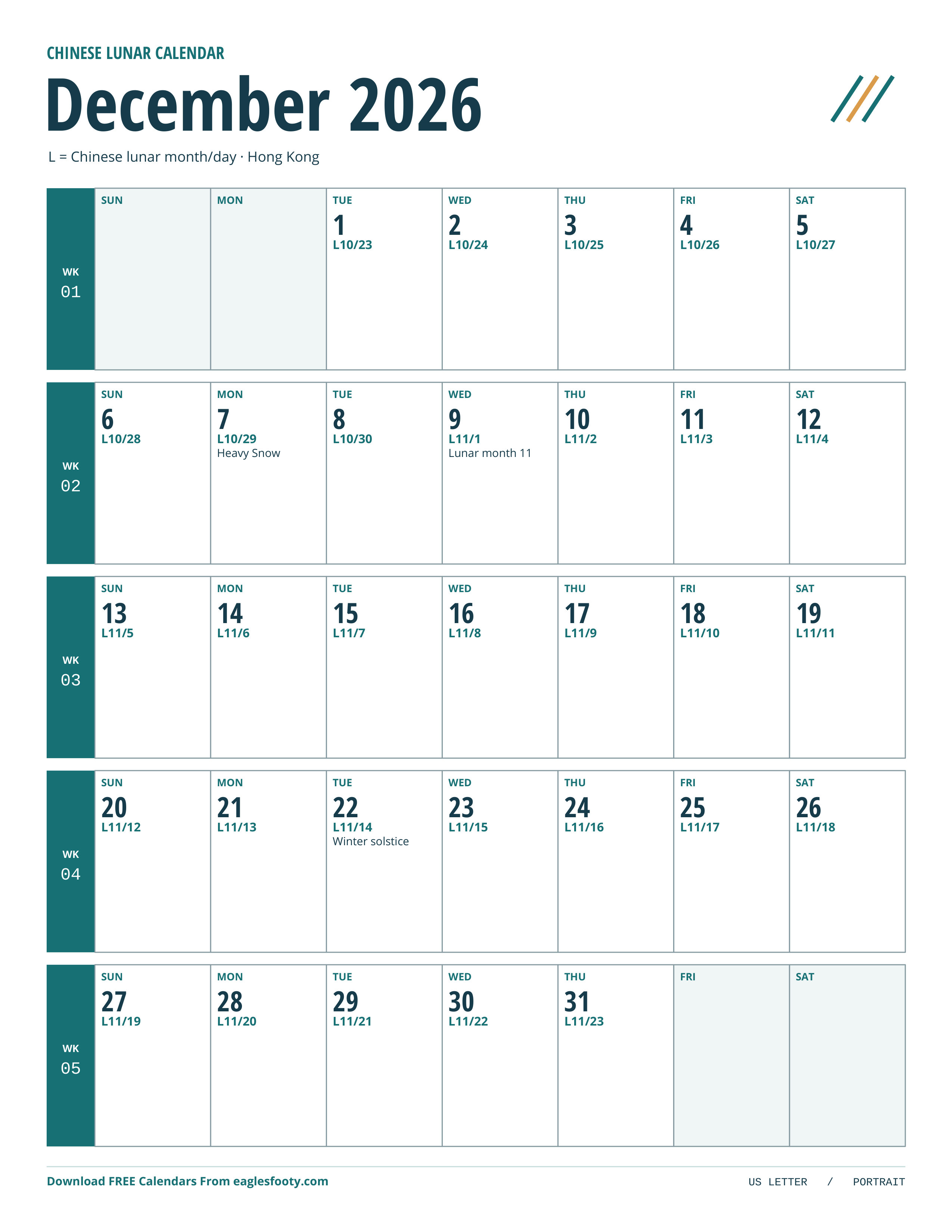
Chinese Calendar 2026 December lets you look up the Chinese lunar date for any day of the civil month. Tuesday, December 1, is the 23rd day of lunar month 10. Wednesday, December 9, begins lunar month 11, and December 31 is its 23rd day. These conversions use the Hong Kong Observatory’s calendar for the Bing-wu Year of the Horse.
To copy a converted date onto a plain monthly planner, open the December 2026 Calendar collection.
Chinese Calendar 2026 December: Date Conversion Guide
How to Convert a December Date
Locate the Gregorian day first. Read the smaller lunar label beside it as month followed by day. For example, L10/23 means lunar month 10, day 23. The letter L identifies the sequence as a lunar date so a US reader is less likely to enter October 23 into a regular date field. When sharing the result outside the household, write the month and day in words.
December has one lunar month boundary. December 1 through 8 correspond to days 23 through 30 of month 10. December 9 through 31 correspond to days 1 through 23 of month 11. Counting inclusively from December 9 is a quick cross-check. December 9 itself is day one, so December 15 is day seven. Starting at zero would place every date in the second part of the month a day too early.
Chinese Calendar 2026: December Conversion Examples
| Gregorian Date | Chinese Lunar Date | What to Notice |
|---|---|---|
| Tuesday, December 1 | Month 10, day 23 | The civil month begins late in a lunar month. |
| Monday, December 7 | Month 10, day 29 | Heavy Snow is a solar term on the Hong Kong calendar. |
| Tuesday, December 8 | Month 10, day 30 | This is the final day of the tenth lunar month. |
| Wednesday, December 9 | Month 11, day 1 | Restart the lunar count in the middle of the civil week. |
| Friday, December 18 | Month 11, day 10 | Ten days of the new lunar month have elapsed by the end of this day. |
| Tuesday, December 22 | Month 11, day 14 | Dongzhi, the winter solstice, falls on this date in Hong Kong. |
| Thursday, December 31 | Month 11, day 23 | The lunar month continues into the next civil year. |
Finding a Gregorian Date From a Lunar Birthday
Reverse the lookup when a relative supplies a lunar date. For a birthday on the sixteenth day of the eleventh month, begin at December 9 and move forward fifteen days. The result is Thursday, December 24. A birthday on the twenty-third day needs the month name as well. Lunar 10/23 maps to December 1 and lunar 11/23 maps to December 31. Both matches appear on this single page.
- Ask for the lunar month number, the day number, and the calendar year the person wants to look up.
- Locate the month boundary on the printed grid and read across to the correct lunar day.
- Copy the resulting Gregorian date onto the invitation with its weekday and year fully written out.
- Keep the original lunar date in the family record so it can be converted afresh in another year.
For a photo album, a two-line caption works well. The first line might read “Thursday, December 24, 2026, Hong Kong.” The second can say “sixteenth day of lunar month eleven.” Someone researching the family years later can identify both the civil date and the place used for the conversion. A solitary label such as 11/16 leaves the reader guessing whether it means November 16 or a date in a lunar calendar.
Solar Terms and the Lunar Month
The traditional Chinese calendar combines lunar months with a seasonal solar framework. Heavy Snow and the winter solstice belong to the solar terms. Neither name promises local weather. A family in Florida can record Heavy Snow on December 7 without expecting snowfall, just as a Hong Kong family can observe Dongzhi on the locally published date while relatives across the Pacific use a different clock for the astronomical event.
- Use the lunar label for a traditional birthday or month-day conversion.
- Use the named solar term for a seasonal note such as Dongzhi.
- Use a local time conversion for the start of a dinner, livestream, or other appointment.
- Include the source city when comparing a US almanac with a date printed for Hong Kong.
Sharing a Date Across the Pacific
When sharing a December date from the Chinese calendar for 2026, send the reference location along with the lunar month and day. That short label makes the conversion easier to check later.
An appointment belongs to a place and time. A calendar correspondence associates two date systems under a stated convention. Suppose a relative writes “Dongzhi dinner, 7 p.m. Hong Kong.” First use the dated invitation to identify December 22. Then convert the time for the person joining remotely. Moving the date of the entire Chinese calendar because the call happens on a different local day would create errors elsewhere on the page.
Leave one margin free for the family’s preferred Chinese characters or romanization. People who learned the date orally may find a familiar spelling more useful than a fresh translation. Keep the lunar month number visible next to those notes, especially in the first and last weeks where day 23 occurs twice. The Hong Kong Observatory conversion table gives the full year, and the Observatory’s December almanac identifies the solar terms for the month.