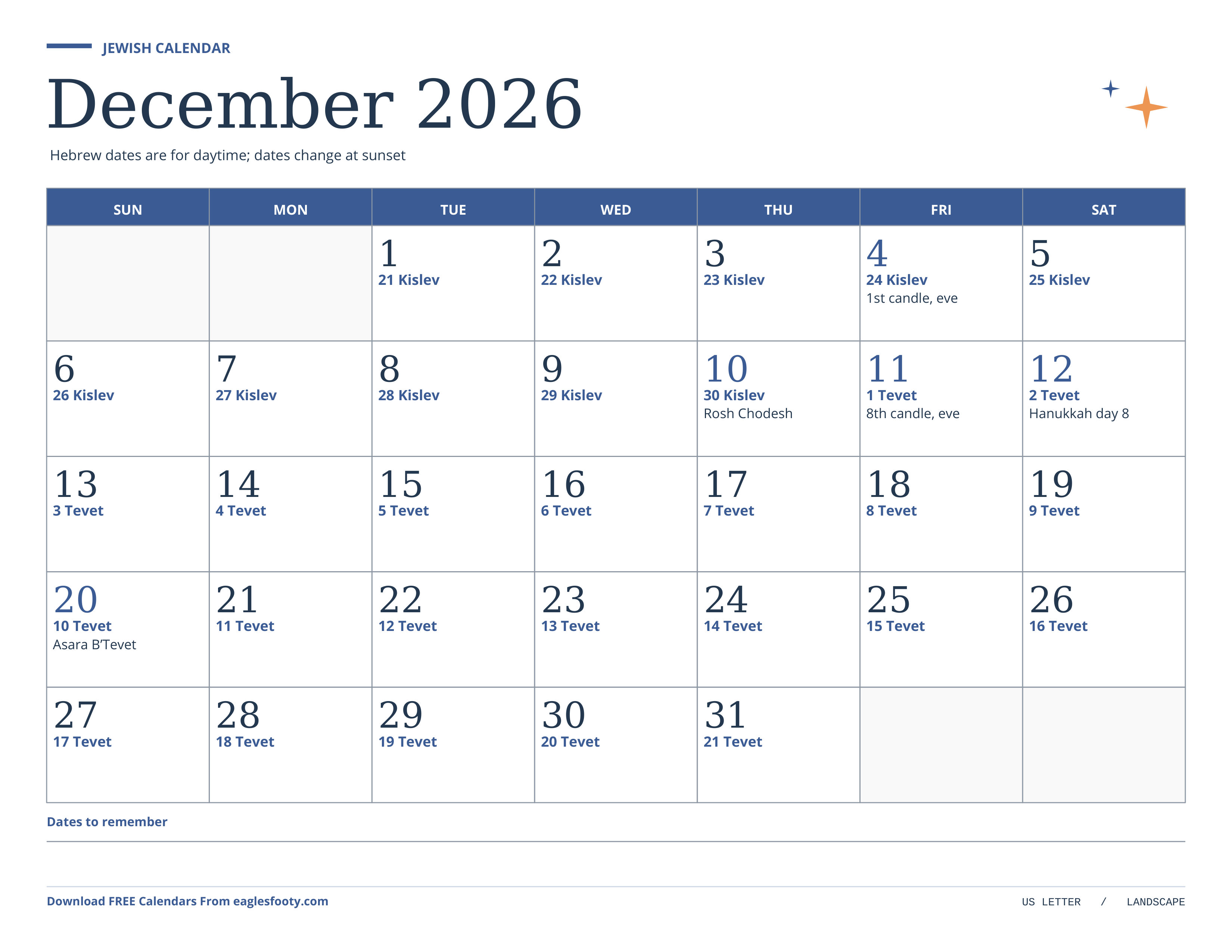
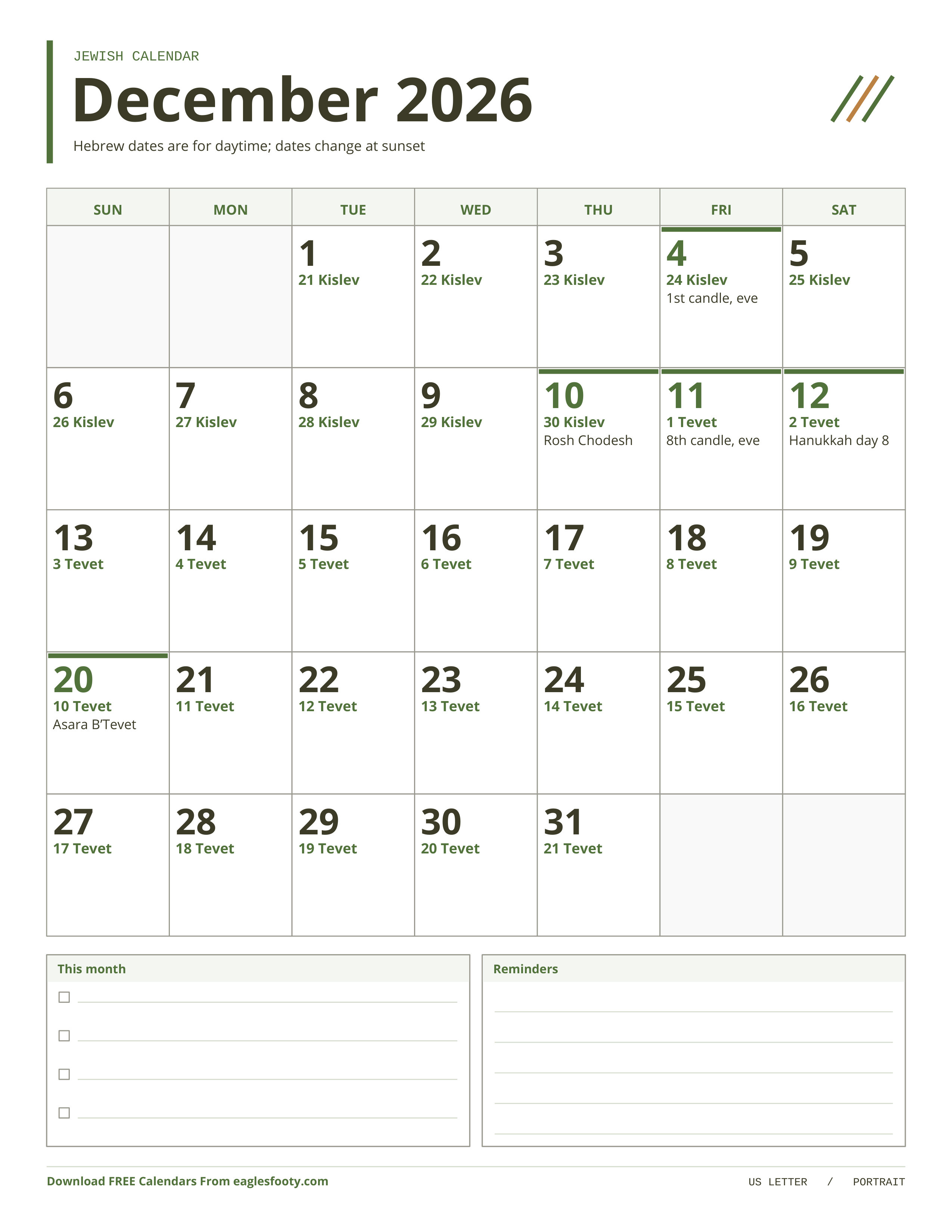
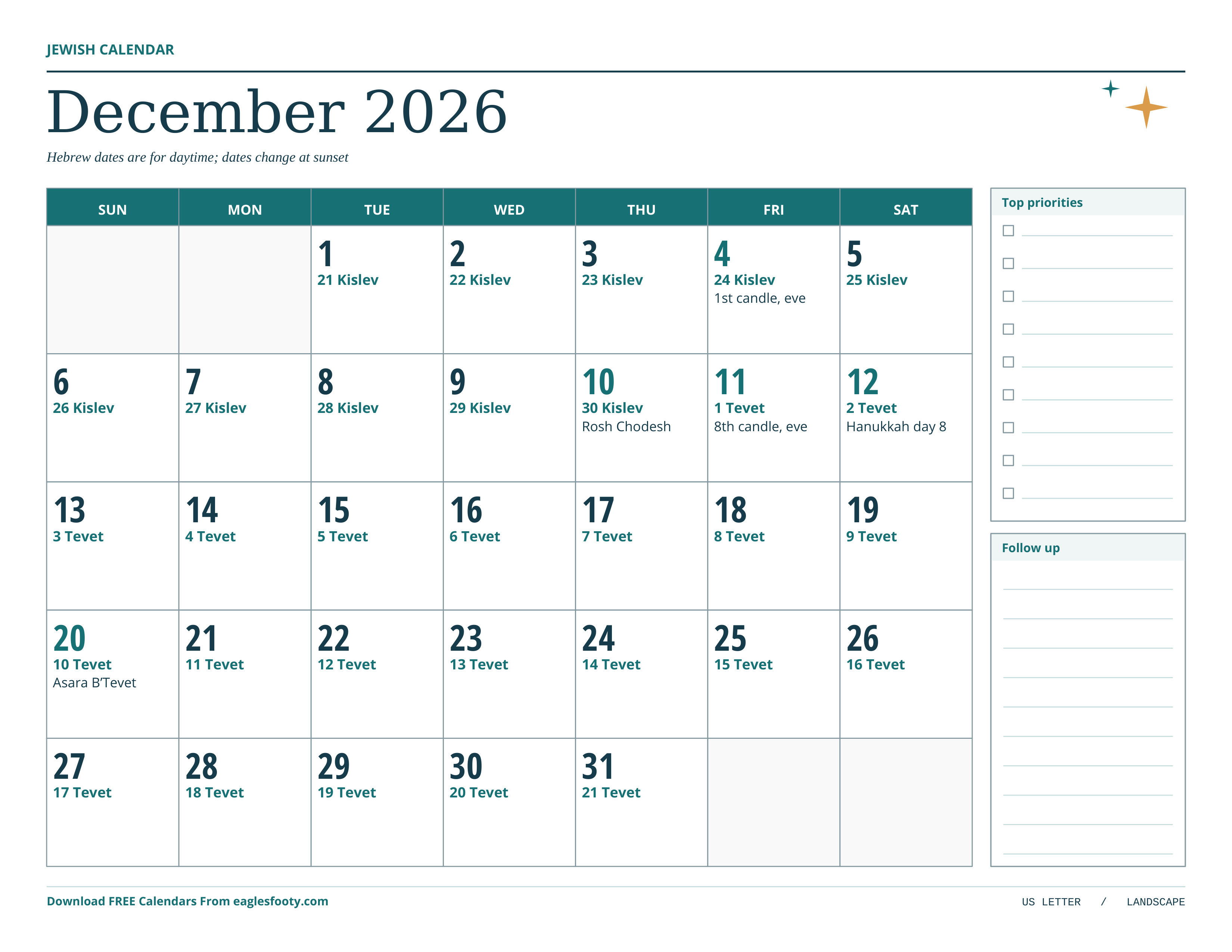
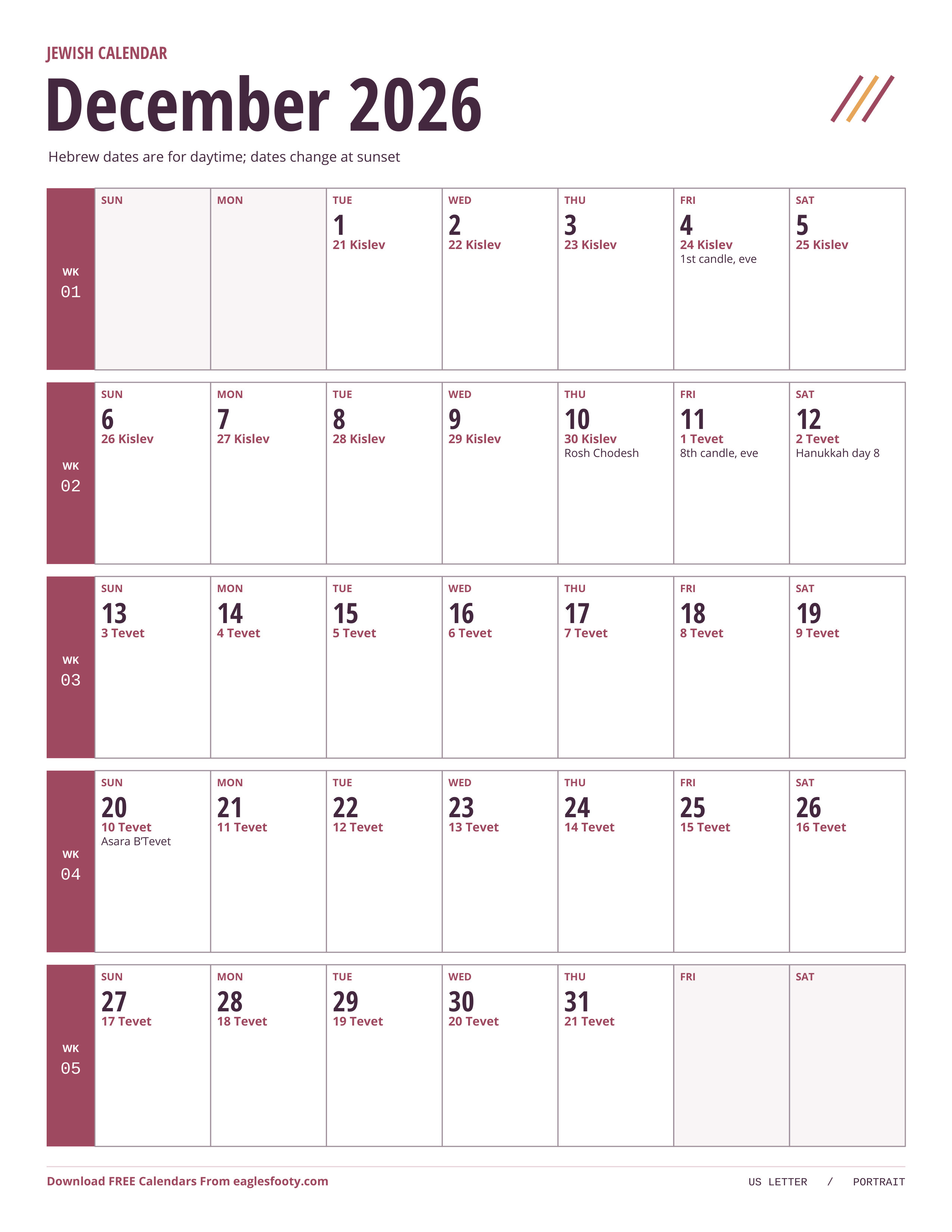
December 2026 Jewish Calendar pairs every civil date with its daytime Hebrew date in year 5787. Tuesday, December 1, is 21 Kislev. Friday, December 11, is 1 Tevet, and Thursday, December 31, is 21 Tevet. Hanukkah begins at sunset on Friday, December 4, and ends after nightfall on Saturday, December 12. The evening boundary matters whenever you put a gathering on a civil calendar.
For a December civil-date reference to use beside the Hebrew grid, print the December 2026 Calendar collection.
December 2026 Jewish Calendar: Gregorian & Hebrew Dates
Reading Daytime and Evening Dates
The Gregorian date changes at midnight. A Jewish date begins the evening before its corresponding daylight hours. The secondary labels on this calendar identify the Hebrew date during the daytime of each Gregorian box. For instance, Friday, December 4, is 24 Kislev during the day. With the arrival of evening it becomes 25 Kislev and the first night of Hanukkah. Saturday, December 5, is the first daytime date of the holiday.
That convention is particularly useful for keeping a birthday, invitation, or family archive. If a relative gives a civil birthday and says the birth happened after sunset, a simple daytime lookup can identify the preceding Hebrew date by mistake. Record the place and approximate time along with the civil date. For a question about the period around sunset, ask the family or its religious authority how to record it.
Hebrew Date Checkpoints in December
| Civil Date During the Day | Hebrew Date | Evening or Holiday Detail |
|---|---|---|
| Tuesday, December 1 | 21 Kislev 5787 | Kislev continues into the second week of December. |
| Friday, December 4 | 24 Kislev | The first evening of Hanukkah begins at sunset. |
| Saturday, December 5 | 25 Kislev | This is the first daytime date of Hanukkah. |
| Thursday, December 10 | 30 Kislev | The first day of Rosh Chodesh Tevet is still in Kislev. |
| Friday, December 11 | 1 Tevet | The second day of Rosh Chodesh and the eighth Hanukkah evening share this civil date. |
| Saturday, December 12 | 2 Tevet | Hanukkah ends after nightfall. |
| Sunday, December 20 | 10 Tevet | Asara B’Tevet falls on this date. |
| Thursday, December 31 | 21 Tevet | The Hebrew month continues into January. |
Marking Hanukkah on a Shared Calendar
A family arranging a first-night gathering can put a small mark in the December 4 square and a separate line for the invitation time. This year the first and last candle-lighting evenings fall on Fridays. The relationship to Shabbat makes local timing especially important. A generic sunset reminder cannot supply all the timing details your household may follow. Consult the congregation or a city-specific Jewish calendar for the appropriate schedule.
- Start with Friday evening, December 4, and mark it as the first night.
- Count forward one civil evening at a time through Friday, December 11, the eighth evening.
- Leave Saturday, December 12, marked as the eighth daytime observance through nightfall.
- Add the actual address, gathering time, and city only when the organizer confirms them.
Consider a family in Boston sending a note to grandparents in Arizona. “Fourth night, Monday, December 7” identifies the occasion, but a video call still needs a local start time. Put the Boston time and the grandparents’ local time on the invitation. When each household needs ritual timing, look it up for the respective location. The time selected for the video call may serve a different purpose from the candle-lighting time.
Finding a Hebrew Date Without Counting Every Square
- For December 1 through 10, add twenty to the civil day number to get the daytime day of Kislev.
- For December 11 through 31, subtract ten from the civil day number to get the daytime day of Tevet.
- Write the month name beside every result, especially for the number twenty-one, which appears twice.
- Use these shortcuts only for this December and verify the next month separately.
For example, a daytime event on December 17 is on 7 Tevet. If an invitation says 9 Tevet and gives a daytime start, count forward from Tevet 1 on December 11 to Saturday, December 19. An “evening of 9 Tevet” requires clarification about the civil gathering date. Writing both dates and a clock time on the invitation removes a common ambiguity for guests who use different calendars.
Rosh Chodesh and the Tenth of Tevet
Kislev has thirty days in this year. Rosh Chodesh Tevet therefore spans Thursday, December 10, and Friday, December 11. Its first daytime box still reads 30 Kislev. Someone looking for the Hebrew label “1 Tevet” alone would miss the first of the two days. On the printed sheet you can bracket the two boxes and write the name once above them.
Asara B’Tevet falls on Sunday, December 20. If you need local fast times, obtain them for the city where you will actually be on that day. A traveler may start the month at home and be visiting another community by the twentieth. Keep that location beside the reminder and include the local synagogue contact if the schedule is for a group. The date conversions and holiday sequence follow Hebcal’s 2026 Diaspora calendar.
1 thought on “December 2026 Jewish Calendar: Gregorian & Hebrew Dates”