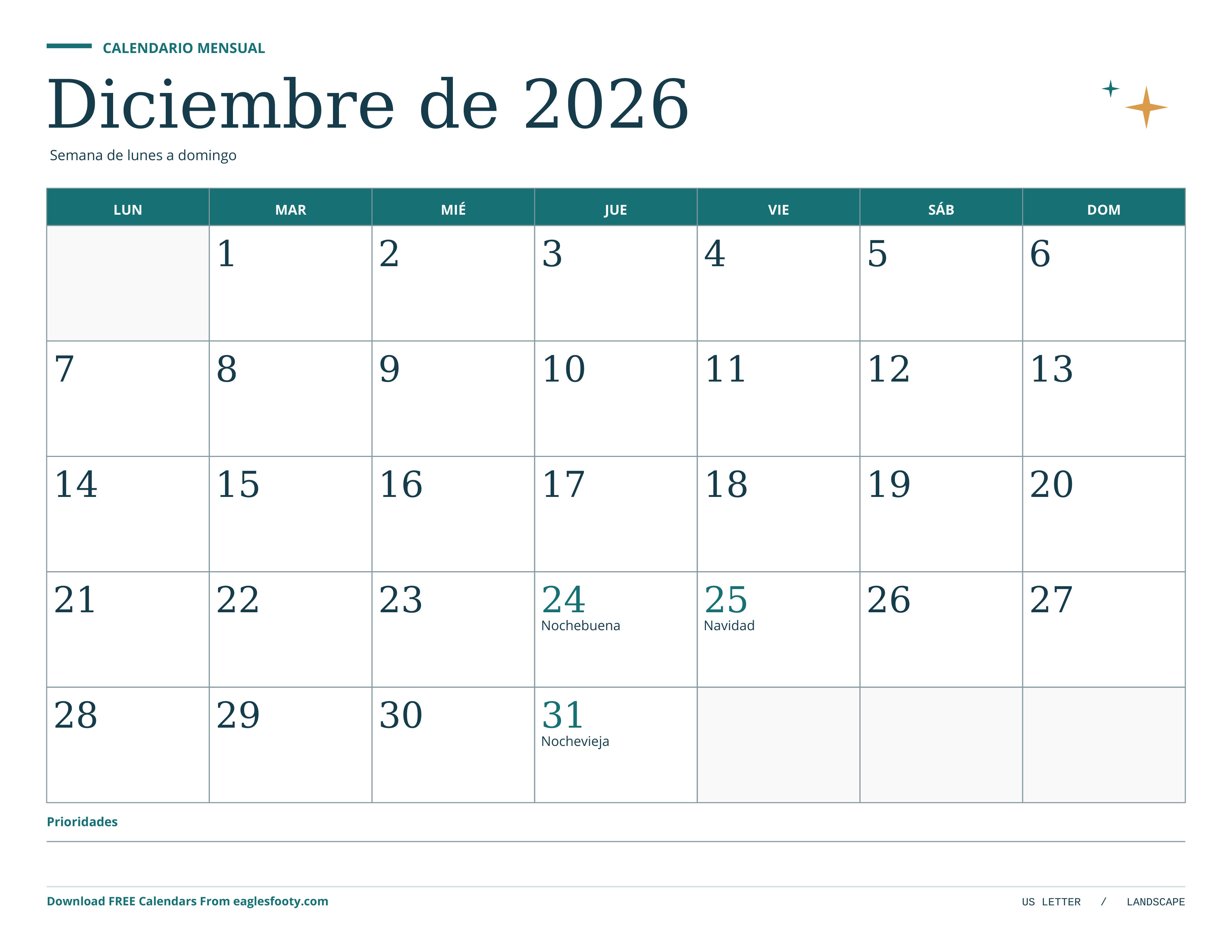
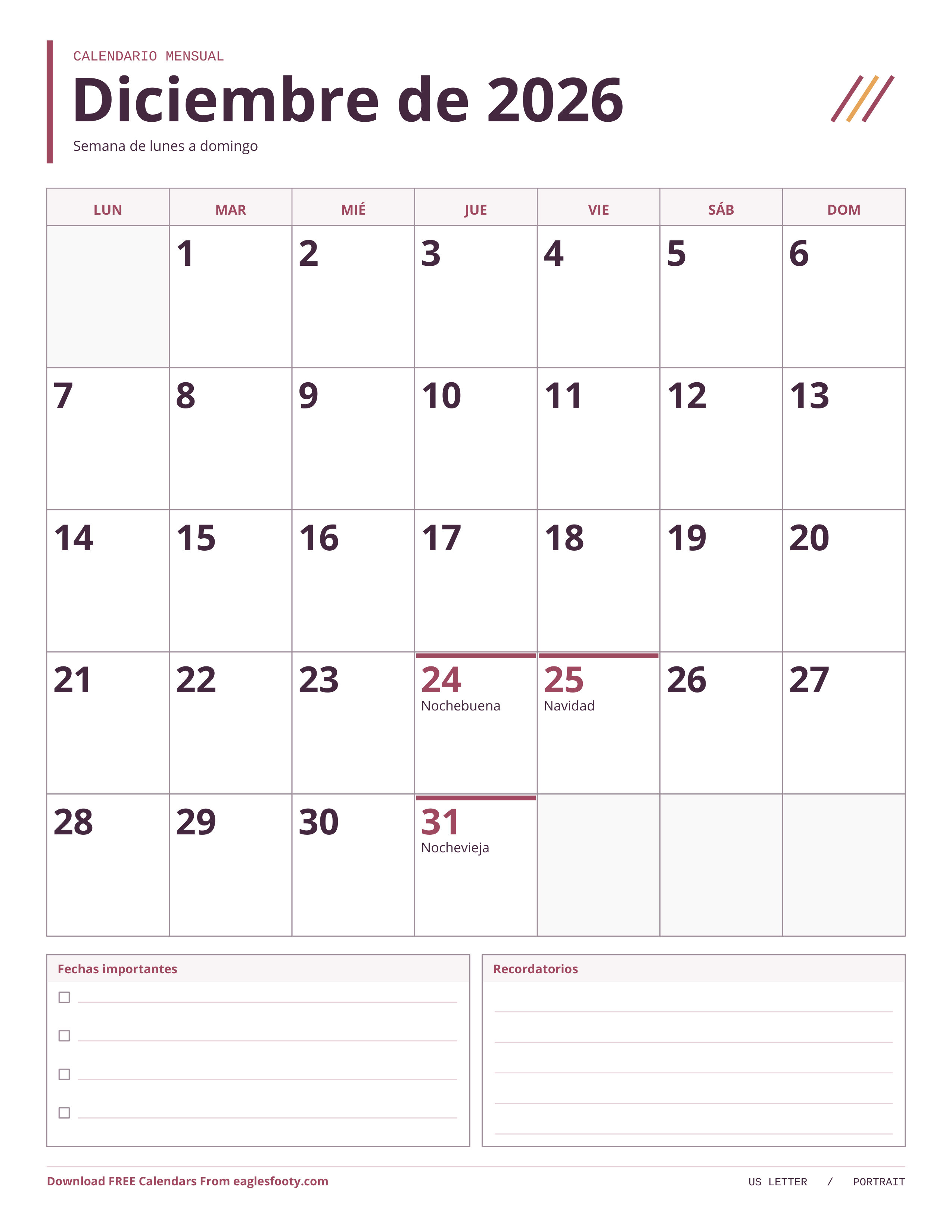
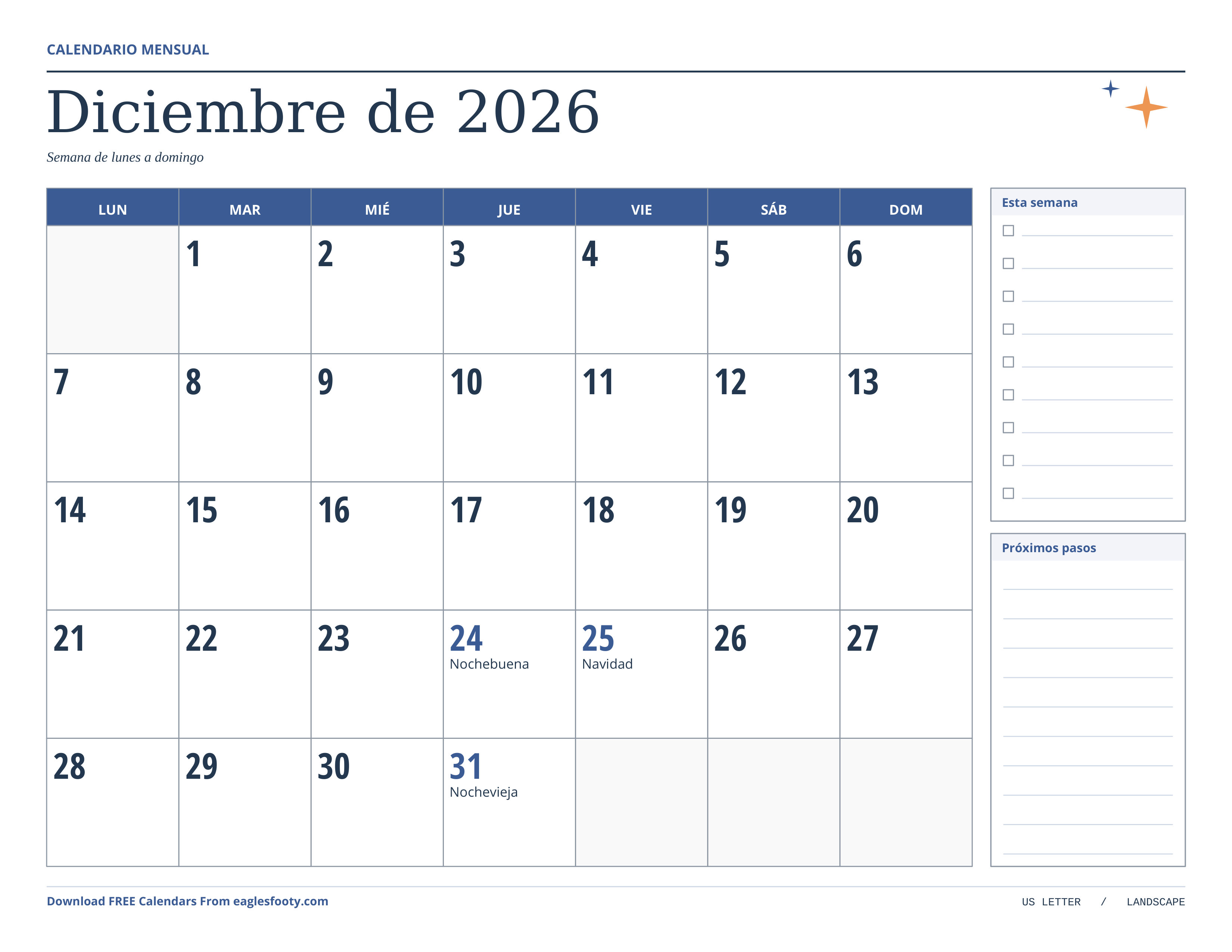
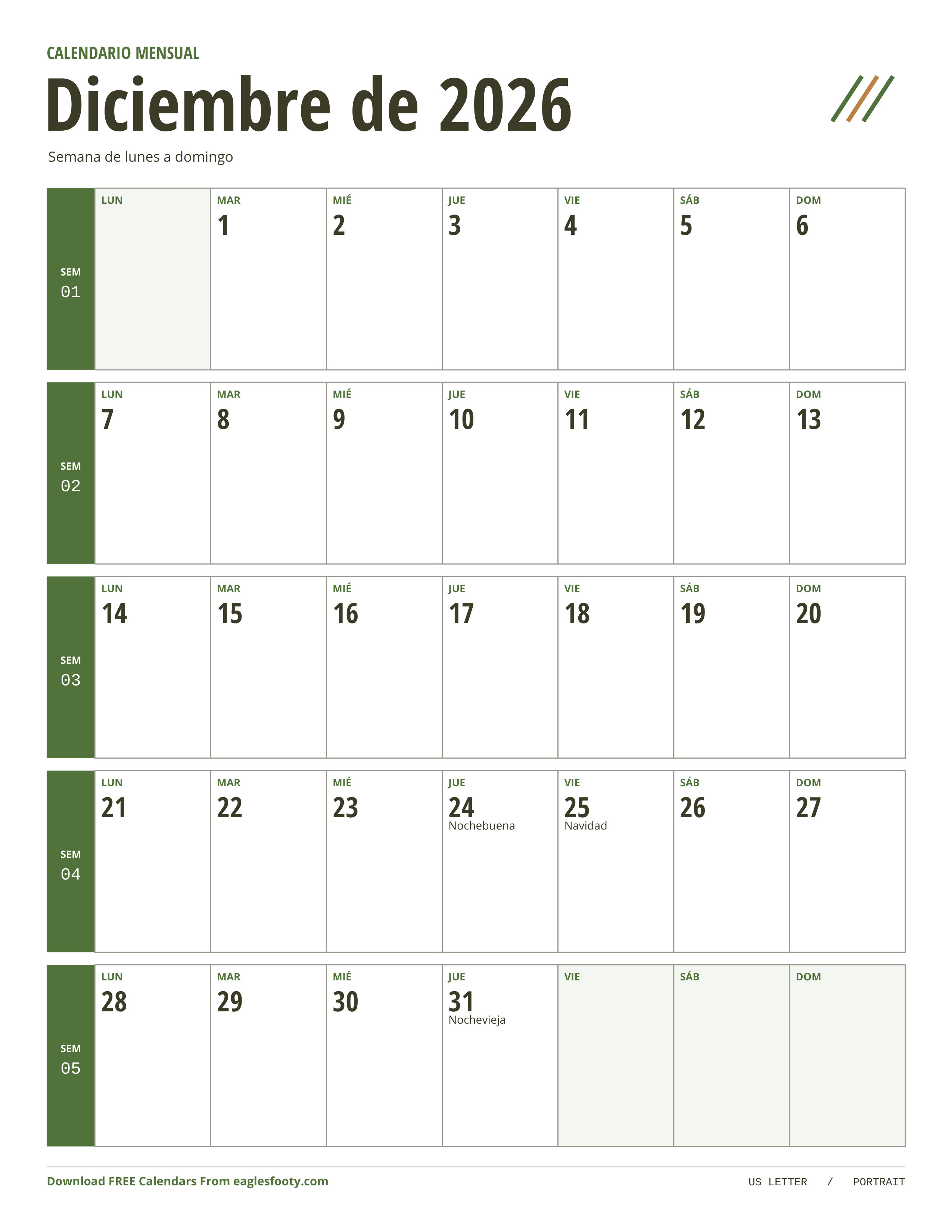
December 2026 Calendar in Spanish printables give you a month labeled diciembre de 2026, with the week running from lunes to domingo. December 1 falls on martes, Tuesday. Christmas Day is viernes 25 de diciembre, and the month ends on jueves 31 de diciembre. The grid works for a bilingual household, a Spanish class, or an invitation board where families want to read the same date in either language.
Families who want an English-language companion can print the December 2026 Calendar collection.
December 2026 Calendar in Spanish for Monthly Planning
How to Read a December 2026 Calendar in Spanish
Start by finding the weekday labels. A US reader accustomed to a Sunday-first month might instinctively look at the leftmost column for Sunday. Here the left edge begins with Monday and the weekend closes the row. The first Tuesday is next to the blank Monday cell. Once you locate the first of the month, count along to Friday the fourth or down the same column to Tuesday the eighth. The pattern holds through Thursday the thirty-first.
| Spanish weekday | English weekday | First occurrence this month |
|---|---|---|
| lunes | Monday | December 7 |
| martes | Tuesday | December 1 |
| miércoles | Wednesday | December 2 |
| jueves | Thursday | December 3 |
| viernes | Friday | December 4 |
| sábado | Saturday | December 5 |
| domingo | Sunday | December 6 |
Write a Date That Both Readers Recognize
For a note in Spanish, put the day before the month. “El concierto es el viernes 18 de diciembre” means that the concert is on Friday, December 18. If an invitation will be kept for more than a few weeks, include the year as well. A numeric date written as 12/4/2026 can send two readers to different squares. Writing 4 de diciembre de 2026 removes the ambiguity in a message about the first Friday.
In ordinary Spanish sentences, month and weekday names take lowercase letters unless they start the sentence. Preserve the written accents in miércoles and sábado. A teacher can cover the weekday headings, read a short date aloud, and ask learners to uncover the matching column. Then reverse the activity by pointing to the date and asking a student to say the weekday and month aloud. The same page becomes a reference and a short conversation exercise.
Mark December Celebrations in Spanish
The labels Nochebuena, Navidad, and Nochevieja refer to Christmas Eve, Christmas Day, and New Year’s Eve. In December 2026 they fall on Thursday the twenty-fourth, Friday the twenty-fifth, and Thursday the thirty-first. A holiday label alone says little about when a meal or visit begins. Add an arrival time and a location if the page will serve as the family’s invitation. That extra line matters when one household starts its celebration in the afternoon and another gathers late in the evening.
- Cena de Nochebuena labels a Christmas Eve dinner. Put the time beside it so guests know when to arrive.
- Comida de Navidad identifies a Christmas Day meal. Add a person’s name if several households are hosting.
- Fiesta de Nochevieja describes a New Year’s Eve party. Write the ending time too when transportation depends on it.
Make a Bilingual Invitation From a Calendar Entry
- Choose the square for the event and spell out the weekday in Spanish.
- Add the date and a clear time, including morning or evening when needed.
- Give the place in a form visitors can recognize, such as a school name or street address.
- Read the message once in English and once in Spanish, checking that both versions point to the same square.
Suppose a school is holding an open house on Tuesday, December 15. The Spanish line might read “Visita a la escuela · martes 15 de diciembre · 6 de la tarde.” Under it, the English line can say “School open house · Tuesday, December 15 · 6 pm.” This makes a useful classroom editing exercise. Ask a student to move the event forward one week and rewrite both versions. Tuesday becomes December 22, so the weekday survives even though the number changes.
Use the Month Grid for Language Practice
Try a short weekly routine with a child who already recognizes numbers. On Monday, ask ¿Qué día es hoy? and let the child locate the correct heading. On a second day, ask ¿Cuál es la fecha? and encourage an answer that includes the number and month. A sticker can mark the date without covering the weekday name. Older learners can add an event from a class schedule and ask a partner to find it from the spoken description.
A household bulletin board can use the same approach for ordinary tasks. Choose words everyone uses at home for pickup, practice, library, or dinner. Keep these words beside the calendar for the first week so a new reader does not have to ask about every entry. If a relative prefers English, adding one familiar English word next to a recurring Spanish label is often enough. A complete translation in every square quickly uses up space.
Print for the People Who Will Read It
Choose a page orientation that fits the wall or binder and open the original image before printing. Check whether a child standing at the board can tell martes from miércoles and can read two-digit dates without getting close to the page. If the board is high, place an extra copy at desk level for writing. For formal written invitations, the FundéuRAE guide to writing dates gives the conventional day, month, and year order and the placement of de between the parts.